Humanoid Robot Factory Trials and Korea's Rules
Korea's regulatory sandbox cleared 20 humanoid robots for trials at semiconductor, automotive, shipbuilding and logistics sites on October 13, 2026. The sandbox committee of the Ministry of Trade, Industry and Resources (MOTIR) took up the trial exemption and made it conditional on a risk assessment and risk reduction measures. Industrial robot safety rules written for fixed robots had kept humanoid robots off work sites.
Current as of October 20, 2026.
Illustrative image
Humanoid robot sandbox decision
MOTIR held its sixth Industrial Convergence Regulatory Special Committee meeting of 2026 at the Korea Chamber of Commerce and Industry in Seoul on October 13. The meeting had 16 items: 4 for deliberation and 12 for reporting. The regulatory sandbox grants trial exemptions or temporary permits despite existing regulations in order to foster new technologies and industries.
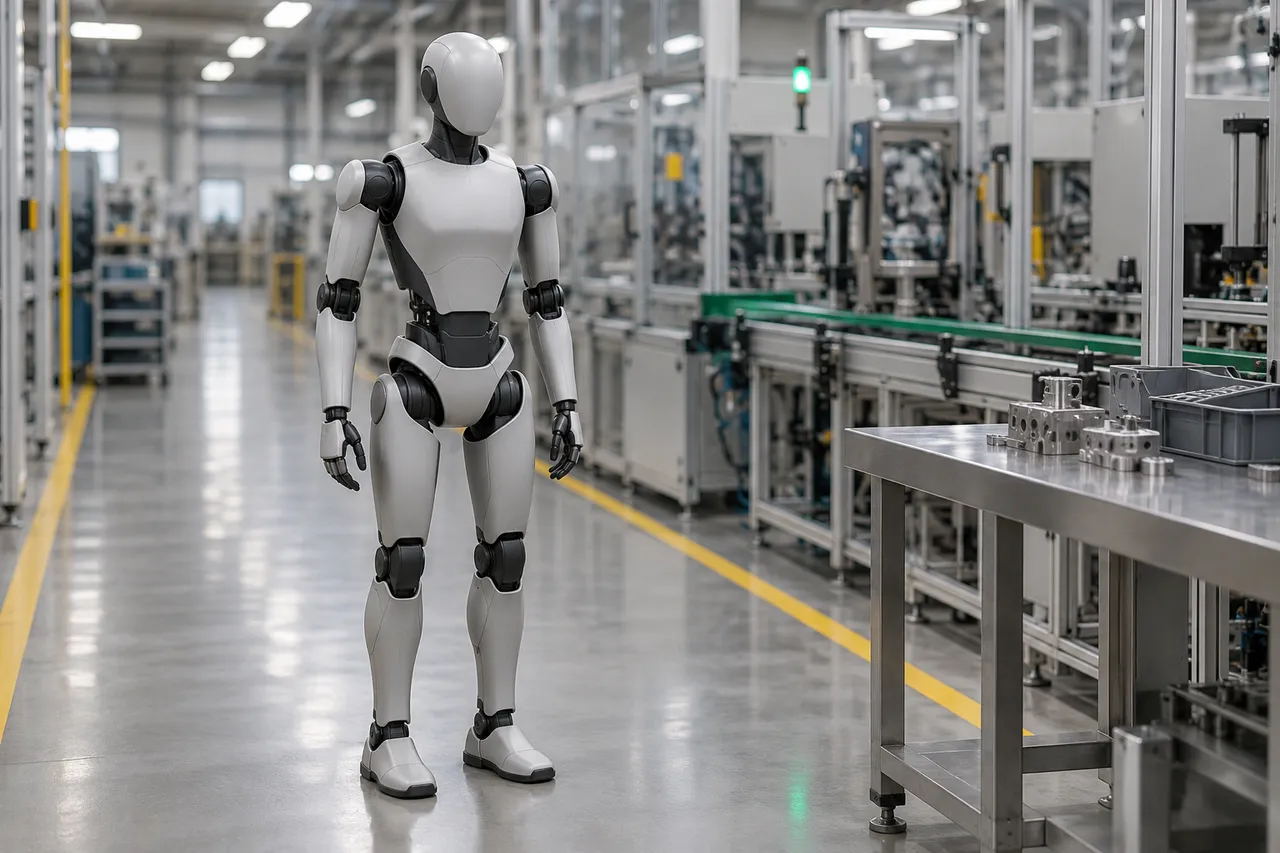
The humanoid project is a reported item filed by Robros and four other companies. Robros will place 20 AI-equipped, two-legged humanoid robots at semiconductor, automotive, shipbuilding and logistics sites, where the robots are to move, recognize, grip, carry and stack items in the same space as workers or next to them.
| Sector | Trial task |
|---|---|
| Semiconductors | Removing contamination from round CRS parts used in back-end packaging |
| Automotive | Placing car body parts |
| Shipbuilding | Stacking jokjang pieces, structural parts attached to fix work platforms (scaffolding) to a hull |
| Logistics | Stacking refrigerated logistics packages |
At the same meeting, the committee approved for the first time a trial in which a four-legged patrol robot patrols pedestrian paths. Under the Intelligent Robots Development and Distribution Promotion Act, an outdoor mobile robot needs an operational safety certification to run on sidewalks, but the current certification could not be applied to four-legged robots. The committee also discussed a plan to streamline regulations proactively for the spread of M.AX (manufacturing AI transformation), and MOTIR plans to prepare, by early 2028, a cybersecurity standard for companies that apply AI on the factory floor.
Robot fence rule
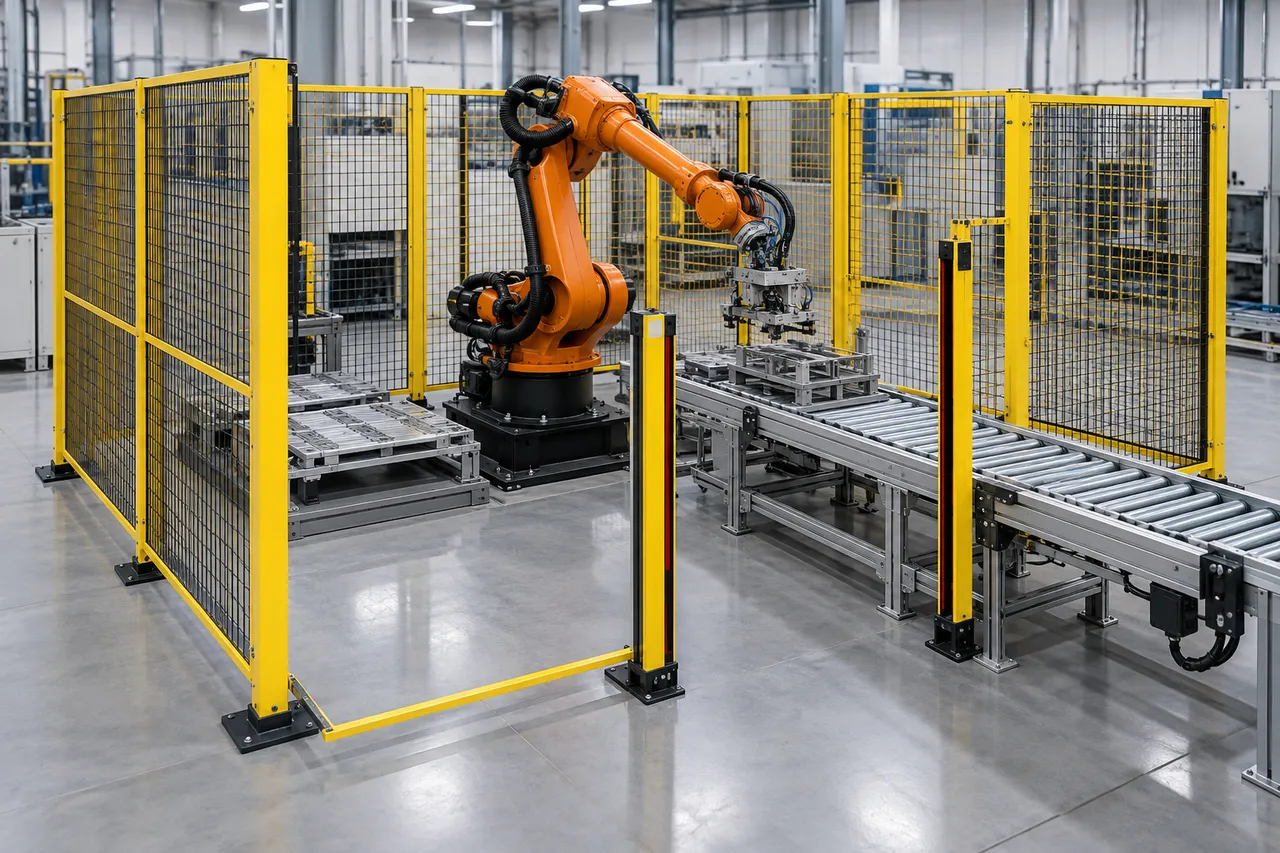
MOTIR's release explains that the current Occupational Safety and Health Standards Rules assume industrial robots are fixed and require safety fences, which has kept humanoid robots that move and share space with people off work sites. Article 223 of the rules requires a fence at least 1.8 meters high to keep robot operation from injuring workers. The fence may be lower where the robot's range of motion and similar factors mean height poses no risk.
Illustrative image
In sections where a fence cannot be installed, for example because of a conveyor system, presence-sensing protection such as safety mats or light curtains must be installed. The proviso of the same article allows the fence and presence-sensing devices to be omitted where the Minister of Employment and Labor recognizes that the robot's safety standards conform to Korean Industrial Standards or internationally accepted safety standards. The fence rule does not apply to operation for teaching or to operation under the proviso of Article 224.
MOTIR's item details explain that current industrial robot safety standards do not suit humanoid robots that move freely while working, which made them hard to use at industrial sites. The committee allowed the trial on the premise of the Ministry of Employment and Labor's risk assessment and measures to reduce the risks. Article 36 of the Occupational Safety and Health Act defines risk assessment as finding hazards from machines, equipment, workers' actions and other sources, deciding whether the size of each risk is acceptable, and setting and carrying out improvements that reduce it. MOTIR expects the trial to yield data for improving robot safety standards and related rules. The risk assessment procedure is covered in Korean Risk Assessment in 5 Steps: 2026 Guide.
Teaching and maintenance rules
Article 222 sets the measures for teaching work within a robot's operating range. Teaching means setting or changing the operating sequence, position and speed of the manipulator and checking the results. The employer must set guidelines on how to operate the robot and in what order, the manipulator's speed during work, signals when two or more workers are involved, what to do when something abnormal is found, and what to do when restarting a robot stopped because of an abnormality, and must have the work done according to those guidelines.
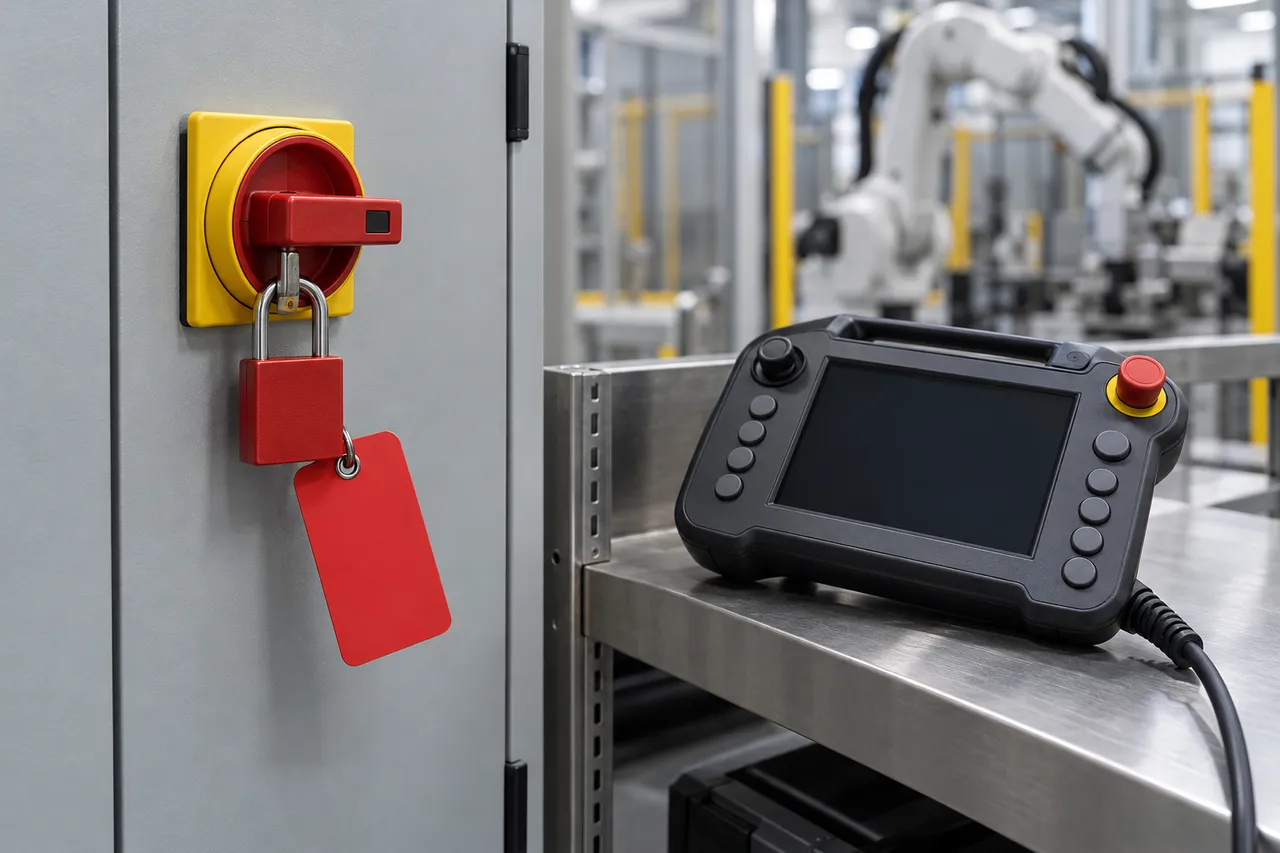
A worker, or the person watching the worker, must stop the robot at once on finding anything abnormal. While the work goes on, the start switch must be marked to show that work is in progress so that no one other than the worker can operate it. Where the robot's power source is cut off for the work, the stop and switch protection measures may be omitted.
Illustrative image
Article 224 requires the robot to be stopped for repair, inspection, adjustment, cleaning, lubrication or result checks within its operating range. During the work, the start switch must be locked with a key that is kept separately, or a sign saying work is in progress must be attached to it, so that no one else can operate it. Where the work can only be done while the robot runs, the robot may keep running if the measures in Article 222 are taken. Energy isolation and restart checks before maintenance are covered in LOTO for Maintenance and Cleaning: Restart Checks.
Certification, self-declaration and inspection
Industrial robots fall under the Occupational Safety and Health Act from manufacture and import through use. Article 77 of the Enforcement Decree names industrial robots as machines subject to self-declaration of safety conformity, and under Article 89 of the Act the manufacturer or importer must confirm that the robot meets the self-declaration safety standards and report to the Minister of Employment and Labor. Article 74 of the Decree makes industrial robot protective devices needed to prevent collisions and trapping, as designated by the minister, subject to safety certification.
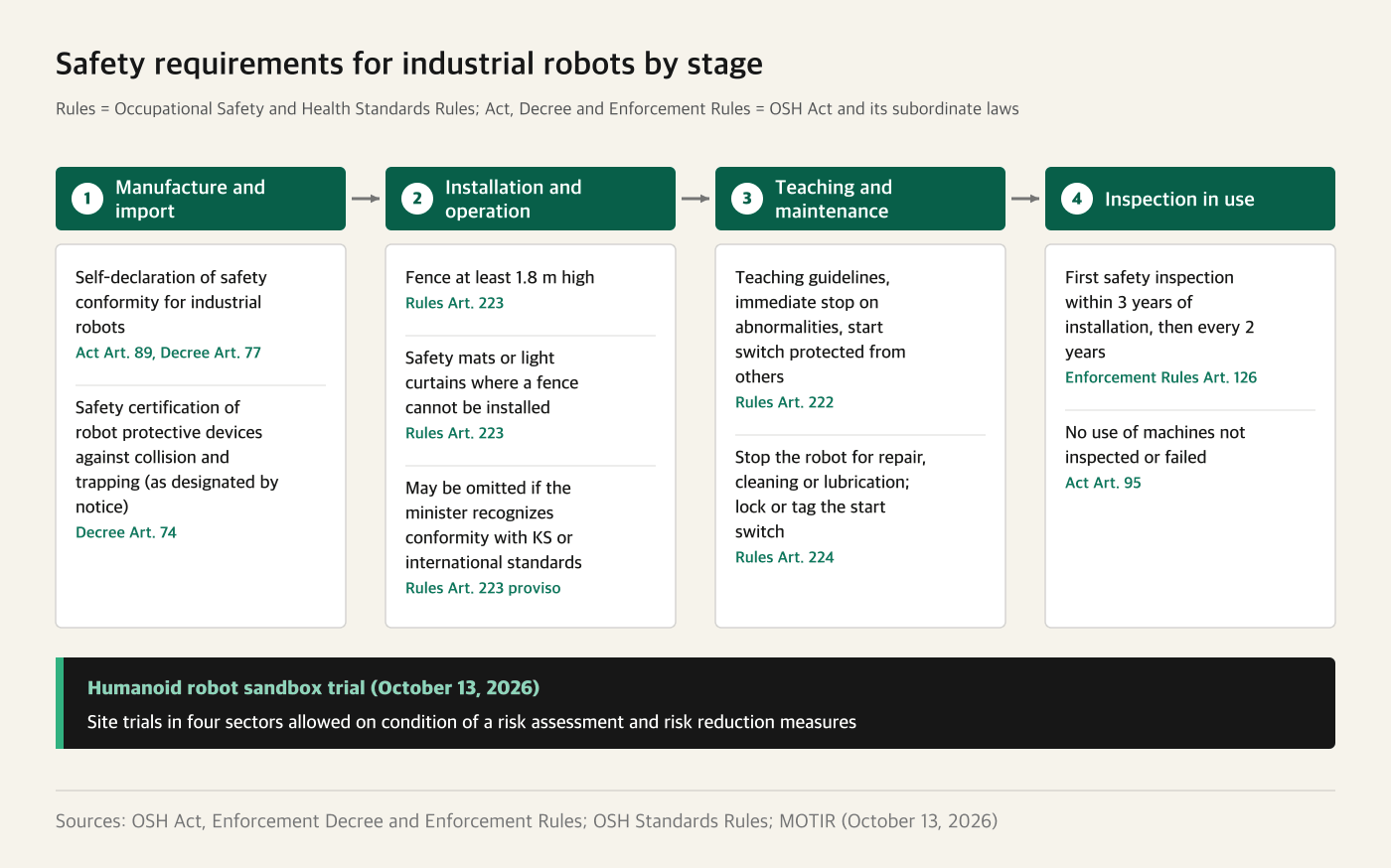
Figure 1. Safety requirements for industrial robots by stage. Source: Occupational Safety and Health Act and subordinate rules; MOTIR (October 13, 2026).
Article 78 of the Decree includes industrial robots among machines subject to safety inspection. Under Article 126 of the Enforcement Rules, the employer must have the first safety inspection within three years of the date installation at the workplace is completed, and every two years after that. Under Article 93 of the Act, where the employer using the machine and its owner differ, the owner must have it inspected. Article 95 of the Act bans the use of machines subject to inspection that have not been inspected or that failed. How to build the list of equipment subject to inspection is covered in 2026 Safety Inspection Expansion: Equipment First.
Field checklist
- List the industrial robots at the site and record, for each robot, the date installation was completed, the date of the first safety inspection and the date the next inspection is due.
- Check that no robot that was not inspected or that failed inspection is running.
- Check that robot cell fences are at least 1.8 meters high, and that any lower fence has a basis in the robot's range of motion.
- Check that safety mats or light curtains are installed and working in sections where a fence cannot be installed.
- Check that teaching guidelines cover the operating method and order, manipulator speed, signals, actions on abnormalities and restart.
- Check that robots are stopped and start switches locked or tagged with a work-in-progress sign before repair, cleaning or lubrication.
- When buying new industrial robot protective devices, check their safety certification; when buying robots, check their self-declaration.
- Where mobile or humanoid robots are under consideration, include work that shares space with workers in the risk assessment.
Summary
The humanoid robot trial uses a risk assessment and risk reduction measures to handle the gap between a fence rule written for fixed robots and robots that move. Sites that run industrial robots should first check the measures in Articles 222 to 224 and their safety inspection schedule. The underlying provisions are available from the National Law Information Center (law.go.kr).
The wider manufacturing AI policy is covered in the Industry Operations Note Korea's M.AX Manufacturing AI: Where to Start.
Official sources
- MOTIR, press release on easing regulations for M.AX (October 13, 2026, Korea.kr)
- National Law Information Center, Occupational Safety and Health Standards Rules
- National Law Information Center, Enforcement Decree of the Occupational Safety and Health Act
- National Law Information Center, Enforcement Rules of the Occupational Safety and Health Act
- National Law Information Center, Occupational Safety and Health Act