Korea's Accident Investigation Reports Go Public
Updated
Korea's labor ministry published 117 more accident investigation reports on October 7, 2026, covering 2023 accidents whose court rulings are final. With the 51 reports that the Ministry of Employment and Labor (MOEL) released on May 27, 2026, the public board now holds 168 reports. Reports on serious accidents that occur on or after June 1, 2026 are published after indictment under the new Article 56-2 of the amended Occupational Safety and Health (OSH) Act.
Current as of October 14, 2026.
Illustrative image
The latest release
An accident investigation report is written by the Korea Occupational Safety and Health Agency (KOSHA) or outside experts after a serious accident and covers how the accident happened, its causes and measures to prevent a recurrence. Ahead of the amended Act taking effect, MOEL published 51 reports on May 27, 2026, covering accidents in 2024 with final court rulings. According to the October 7 release, those 51 reports were viewed more than 50,000 times in four months, about 1,000 views per report.
The 117 reports added now cover accidents in 2023 with final rulings. The Act covers serious accidents on or after June 1, 2026, but MOEL is also publishing reports on earlier cases. MOEL plans to publish, step by step, reports on cases that have been indicted and are still at trial even where no final ruling exists.
The reports are on the accident investigation report board under the information disclosure menu of the MOEL website, and in the accident investigation report menu of the KOSHA safety portal. The board can be searched by accident period, industry, company size (under 50, or 50 and over), region (17) and accident type.
Legal basis for publishing accident investigation reports
The legal basis is the amended OSH Act, promulgated on February 19, 2026 and in force since June 1. MOEL included publication of the reports in its comprehensive occupational safety plan of September 15, 2025, and the amendment revised the cause investigation article and added an article on writing and publishing reports.
| Article | Content |
|---|---|
| Article 56(2) and (3) | The Minister can have KOSHA or outside experts carry out a separate cause investigation; investigators can enter the site, interview the people involved and request documents |
| Article 56(5) | No one may damage the site of a serious accident or obstruct the cause investigation |
| Article 56-2(1) | KOSHA or the outside experts write a report covering the causes and recurrence prevention measures and submit it to the Minister |
| Article 56-2(2) | Published after indictment in the case, to prevent similar accidents; cases not subject to investigation or trial can be published regardless of indictment |
| Article 56-2(3) | Matters under Article 9(1) items 2 (national security and similar), 6 (personal information) and 7 (business secrets) of the Official Information Disclosure Act can be withheld |
| Addendum Article 3(1) | Article 56 (except paragraph 1, item 2) and Article 56-2 apply to serious accidents occurring on or after June 1, 2026 |
Article 71-2 of the Enforcement Rule was added on May 29, 2026 and took effect on June 1. It defines the cases that can be published regardless of indictment as those that are not subject to investigation or trial because a preliminary inquiry was closed or a decision not to indict was made. Reports are published by posting them on the MOEL website and by other means.
How reports are written and published
MOEL Notice No. 2026-38, Regulations on Accident Cause Investigations and Accident Investigation Reports, was issued on May 29, 2026 and took effect on June 1. Under Article 7 of the notice, a report covers an overview of the workplace, how the accident happened, its causes, and recommendations to prevent the same or similar accidents. KOSHA or the outside experts write the report regardless of the employer's legal obligations and must state that its content is unrelated to the outcome of any investigation into legal violations.
KOSHA or the outside experts carrying out the investigation must tell the employer that the report will be published later and explain the procedure for raising concerns about business secrets and similar matters. Once an indictment, a decision not to indict or the closing of a preliminary inquiry is confirmed, KOSHA sends the report to the employer. An employer with views on parts that should be withheld must submit them within 10 days of receiving it, and the period can be extended by up to 10 days where unavoidable.
Reports on which the employer has submitted views go to the accident investigation report disclosure review committee in MOEL's Occupational Safety and Health Headquarters. The committee has 7 to 10 members including the chair, who is elected from among the outside members. It meets once a quarter and deliberates in closed session. The Minister must publish the reports every month on the MOEL and KOSHA websites, reflecting the committee's review.
In its May release MOEL also said it would change how reports are written. Earlier reports focused on the technical causes of accidents and on establishing legal violations; future reports are to cover structural causes as well, such as how the workplace manages hazards and its safety awareness.
The 168 public reports
As of October 14, 2026, the public board holds 168 reports. By industry, 83 are construction, 50 manufacturing and 35 other. Under the board's company-size classification, 158 fall in the under-50 class and 10 in the 50-or-over class. By severity, 162 involved one or more deaths and 6 involved injuries without deaths; all 6 injury cases are fires, explosions or poisoning in manufacturing.
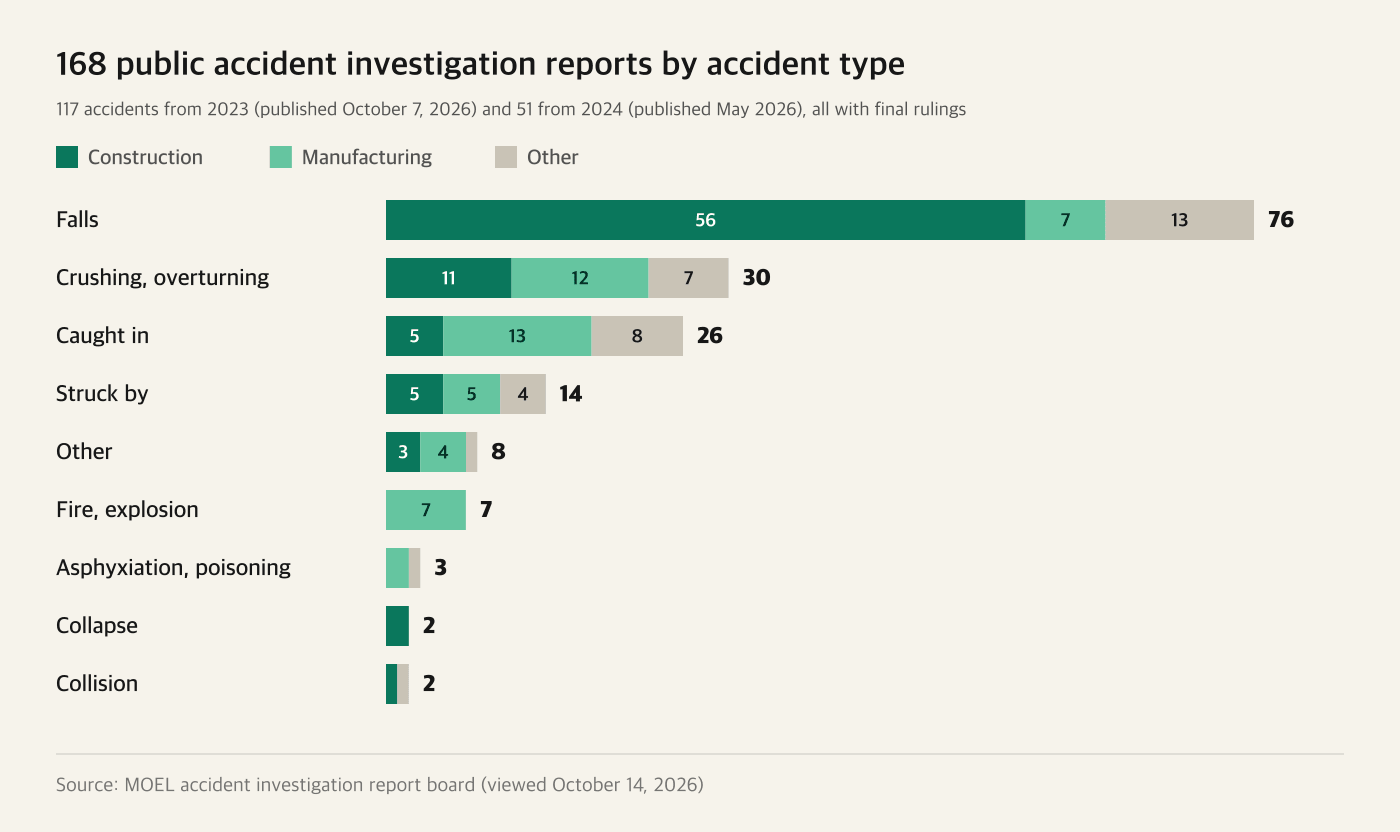
Figure 1. The 168 public accident investigation reports by accident type and industry. Source: MOEL accident investigation report board (viewed October 14, 2026).
Falls are the largest accident type with 76 reports, followed by crushing and overturning with 30, caught-in accidents with 26 and struck-by accidents with 14. Of the 76 falls, 56 are in construction. Among the 50 manufacturing reports, 13 are caught-in accidents and 12 crushing and overturning, and all 7 fires and explosions are in manufacturing. By region, Gyeonggi has 40 reports, Gyeongnam 25, Jeonbuk 21 and Gyeongbuk 20.
An example report
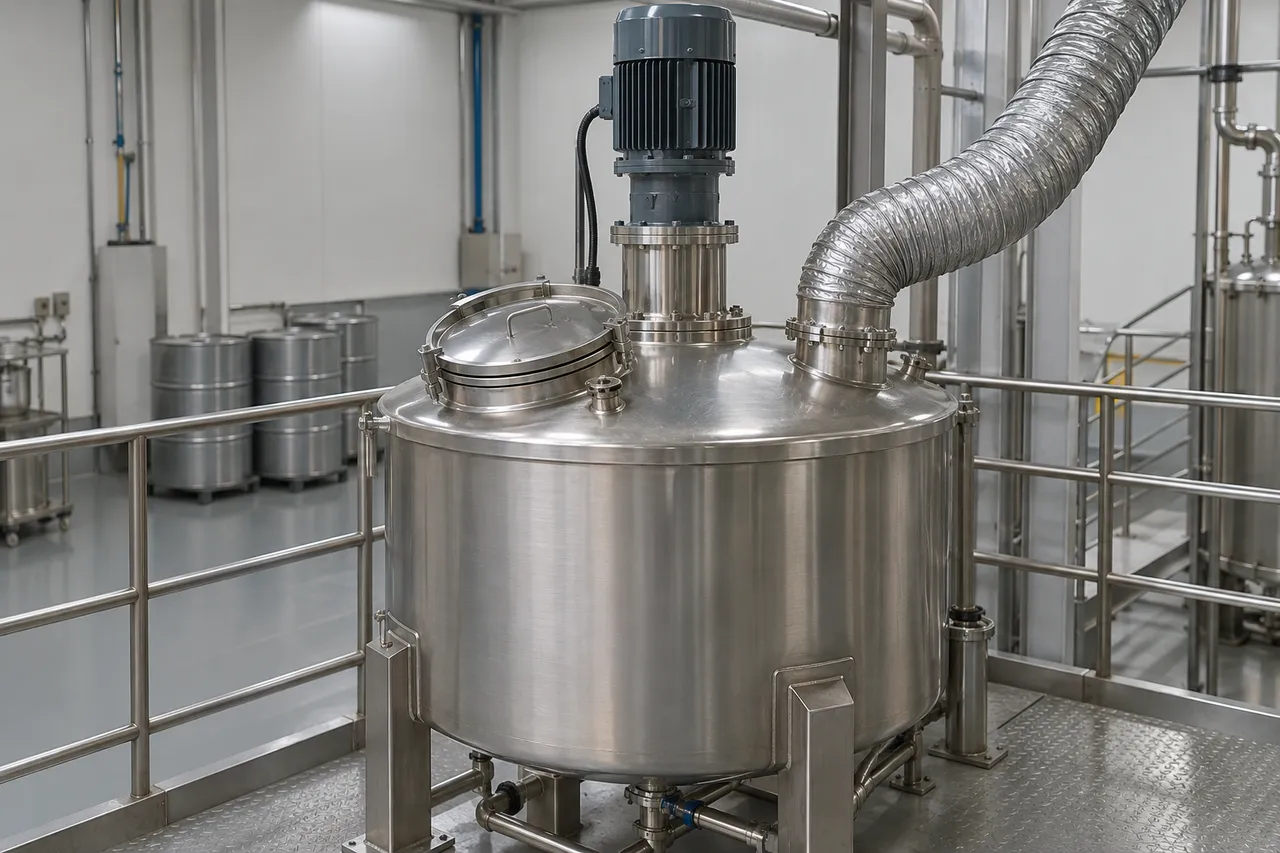
The structure of a public report can be seen in the report on a fire in a paint manufacturing process in Chilgok, Gyeongbuk, on November 15, 2023. One worker suffered burns. Written by KOSHA, the report runs through an overview of the workplace, the injured worker's details and injuries, how the accident happened, the investigation and the investigators' opinion, and it leaves out the company name and refers to the representative and the people involved by letters.
Illustrative image
The investigators' opinion divides the causes into direct and indirect causes. The direct causes were inadequate static control in a process handling flammable liquids, inadequate removal of flammable vapor, and an inadequate safe operating procedure that was also not followed. According to the report, the worker wore ordinary safety shoes, there were no static discharge bars or conductive flooring, and during mixing the vent line isolation valve stayed closed while the opening in the vessel cover was left open.
Among the indirect causes, the report cited a flaw in the protective equipment purchasing procedure: safety shoes without antistatic performance were bought and issued without checking whether they suited the hazards on site. The prevention measures were issuing and wearing antistatic shoes, installing static discharge bars and conductive flooring, making it a rule to open the exhaust isolation valve and close the charging port cover before start-up, and revising the safe operating procedure to reflect the results of process and task risk assessments, among others.
Wider cause investigations from December 2026
Article 56(1) item 2 of the amended Act allows a cause investigation where an industrial accident short of a serious accident results from a fire, explosion, collapse or similar event and an investigation is needed to prevent serious accidents. Under Addendum Article 3(2), this item applies to industrial accidents occurring on or after December 1, 2026.
Article 71(2) of the Enforcement Rule defines these as accidents in which a fire, explosion, collapse, fall, asphyxiation, poisoning, chemical leak, work in extreme heat or similar event injures workers or causes occupational illness, as specified by the Minister in a notice. Article 3 of the notice lists the conditions under which the Minister may judge an investigation necessary: a repeated accident of the same type, a critical condition of the injured worker, multiple simultaneous injuries, and heat stroke from work in extreme heat.
| Category | Condition |
|---|---|
| Repeated type | An accident of the same type, such as a fire, explosion or collapse, at the workplace in the past year |
| Critical condition | Unconsciousness, no breathing, cardiac arrest, amputation or an equivalent critical condition or serious injury |
| Multiple injuries | Two or more workers injured at the same time without reaching a serious accident |
| Extreme heat | Heat stroke with a rise in core body temperature from work in extreme heat |
Links to risk assessment
Article 36 of the amended Act defines risk assessment as identifying hazards, deciding whether the level of risk is acceptable, and setting and carrying out improvement measures to reduce it. Employers must involve workers in the assessment, inform workers of it, and record and keep the results. The amended article applies to risk assessments carried out on or after June 1, 2026.
The prevention measures in the public reports are material that workplaces in the same industry or running the same equipment can consult when identifying hazards in their risk assessments. In the October 7 release, Minister of Employment and Labor Kim Young-hoon said that checking accident cases in their region and industry in the published reports and using them to find and fix hazards would have a strong preventive effect. The steps of a risk assessment are covered in the Field Guide post Korean Risk Assessment in 5 Steps: 2026 Guide.
Illustrative image
Field checklist
- Search the MOEL accident investigation report board by your industry and accident types and review the matching reports.
- Compare the direct causes, indirect causes and prevention measures in the reports with your own equipment and work procedures, and add the relevant items to the hazards in your risk assessment.
- Involve workers in the risk assessment, and inform them of the cases and improvement measures through safety training or pre-work safety meetings.
- Record and keep the risk assessment results and the improvements made in response to the reports.
- Leave the site undisturbed after a serious accident, and name in advance the people who will handle site access, interviews and document requests during a cause investigation.
- Set up a review procedure so that, when a report is sent before publication, views on business secrets or other parts to withhold can be submitted within 10 days.
- From December 1, 2026, an injury from a fire, explosion, collapse, asphyxiation, chemical leak, work in extreme heat or similar event may lead to a cause investigation, so check your accident reporting arrangements.
Summary
MOEL has published 168 accident investigation reports on cases from 2023 and 2024 with final rulings, and reports on serious accidents occurring on or after June 1, 2026 become subject to publication after indictment. From December 1, 2026, industrial accidents in which fires, explosions or similar events injure workers can also be investigated, so workplaces should feed the public reports into their risk assessments and check their accident reporting and investigation response arrangements. The Act and the notice are available from the National Law Information Center (law.go.kr).
The work-stoppage and penalty provisions of a separate OSH Act amendment bill passed by the National Assembly are covered in the Field Guide special edition OSH Act Amendment: Work Stoppage Rights and Fines, and the accident figures for the first half of 2026 in Korea's H1 2026 Work Deaths: Falls Down, Fires Up.
Official sources
- MOEL, 117 more accident investigation reports published (October 7, 2026)
- MOEL, accident investigation reports on serious accidents opened to the public (May 27, 2026)
- MOEL, accident investigation report board
- National Law Information Center, Occupational Safety and Health Act
- National Law Information Center, Enforcement Rule of the Occupational Safety and Health Act
- National Law Information Center, Regulations on Accident Cause Investigations and Accident Investigation Reports (MOEL Notice No. 2026-38)