OSH Act Amendment: Work Stoppage Rights and Fines
On October 1, 2026, Korea's National Assembly passed an amendment to the Occupational Safety and Health Act (OSH Act) that widens workers' right to demand a work stoppage and lets the government fine employers with multiple fatalities up to 5% of operating profit. Most provisions take effect six months after promulgation, while others apply from the day of promulgation or after three months or one year.
This article was written against the Ministry of Employment and Labor (MOEL) press note "Strengthening the role of labor and management in preventing industrial accidents" (October 1, 2026), the bill text and legislative status of the partial amendment to the OSH Act (committee alternative) published on the government's Participatory Legislation Center, and the current OSH Act and Enforcement Decree on the National Law Information Center, as published as of October 8, 2026. The amended act had not been promulgated by that date, and article numbers here follow the committee bill text, so they may differ in the promulgated act.

An illustrative image of bill review work. It does not show actual documents of the National Assembly or MOEL.
Passage and effective dates
The amendment is a committee alternative bill proposed by the chair of the Climate, Energy, Environment and Labor Committee, bill number 2216964. The committee adopted the alternative on February 12, 2026, and the Legislation and Judiciary Committee passed it with amendments on February 23. On October 1, the National Assembly passed the bill without changes at the 10th plenary sitting of its 439th regular session (Participatory Legislation Center).
MOEL said the amendment puts into law the main tasks of the comprehensive labor safety measures the government announced in September 2025 (MOEL press note). Every effective date is counted from promulgation. As of October 8, 2026, the latest OSH Act amendment listed on the National Law Information Center is Act No. 21853, promulgated on July 7, 2026, so the dates for this amendment are not yet fixed.
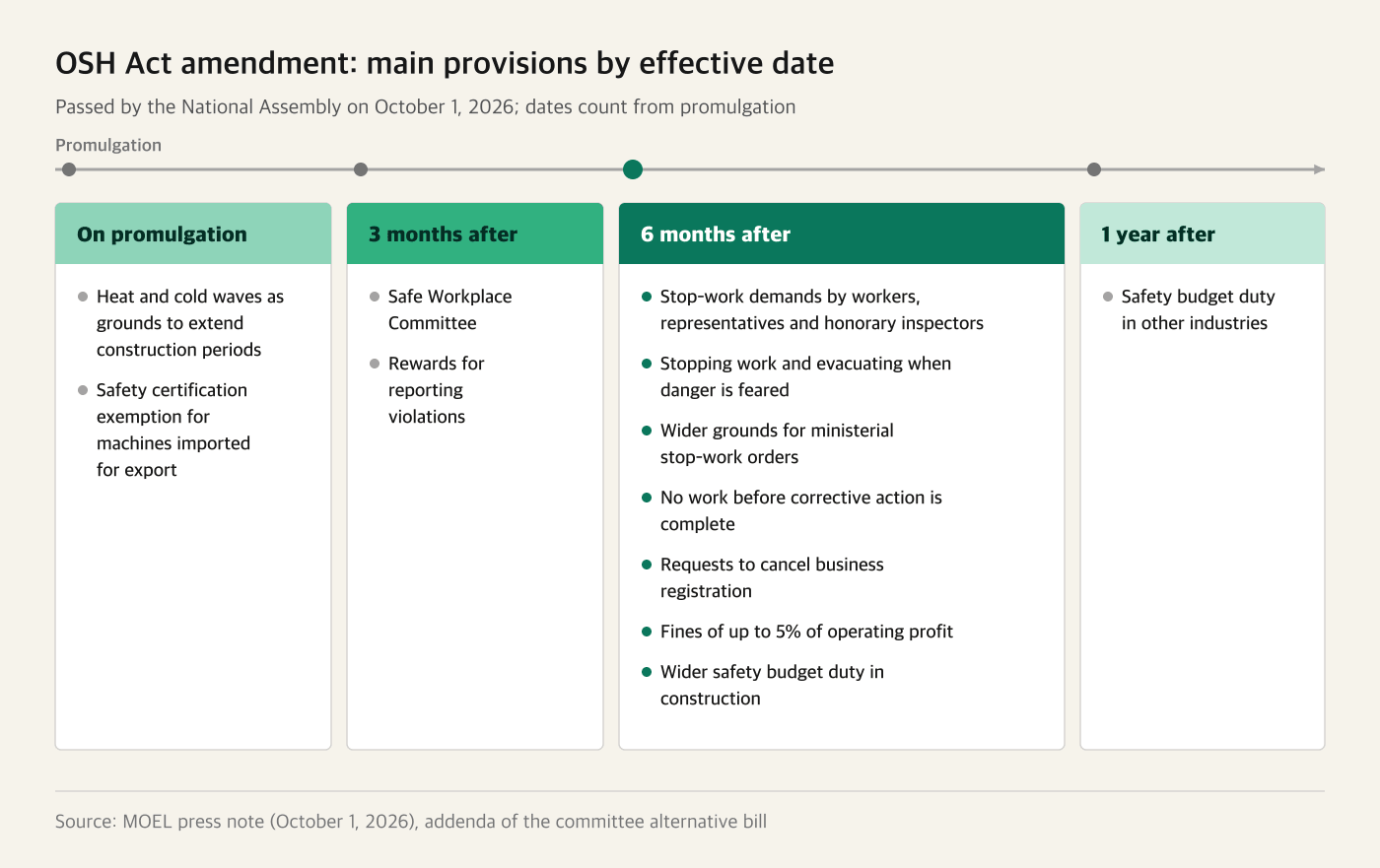
Figure 1. Main provisions of the OSH Act amendment by effective date. Source: MOEL press note (October 1, 2026) and the addenda of the committee alternative bill.
Right to demand a work stoppage
Article 52 of the current act lets workers stop work and evacuate only when there is an imminent danger of an industrial accident. The amendment adds cases where such danger is feared. It also adds provisions to Article 51 that let workers, worker representatives and honorary occupational safety inspectors demand that the employer stop work.
| Item | Current act | Amendment |
|---|---|---|
| When workers may stop work and evacuate | Imminent danger of an industrial accident | Imminent danger, or where danger is feared |
| Who may demand a stoppage from the employer | Not provided | Workers, worker representatives, honorary occupational safety inspectors |
| Whom subcontractor workers may ask | Not provided | The principal contractor as well as their own employer |
| Duty of the employer receiving a demand | Not provided | Stop work unless there is a special reason, no work until measures are complete |
| Adverse treatment | Dismissal of evacuated workers prohibited | Protection extended to workers who demanded a stoppage |
The bill text says feared danger includes cases where the employer's failure to take safety or health measures could cause serious harm. A supervisor who receives a report from a worker who stopped work must not let workers do that work until the necessary measures are complete. If the employer dismisses or otherwise treats unfavorably a worker who stopped work and evacuated, the worker can seek relief from the Labor Relations Commission under Article 28 of the Labor Standards Act.

An illustrative image of a work stoppage. It was not taken at any specific workplace.
Ministerial stop-work orders and work bans before corrective action
Article 55 of the current act lets the Minister of Employment and Labor order the affected work, or the same type of work, to stop only after a serious accident. The amendment widens this to cases such as a worker injured in an accident who is unconscious or whose survival is unknown. The bill text also covers accident injuries that cause serious damage to a worker's body or bodily functions, in cases set by presidential decree.
The amendment also adds a duty for employers under corrective orders, such as installing guardrails, to keep work stopped. MOEL said that where failure to carry out the corrective action leaves an imminent danger of an industrial accident, the employer cannot resume the work until the correction is complete. The bill text applies this duty to work on the machines or equipment concerned where there is an imminent or feared danger, in cases set by MOEL ordinance. The addenda apply this rule to corrective orders issued after the act takes effect, and the wider stop-work grounds to accidents that occur after that date.
Fines of up to 5% of operating profit and registration cancellation
Where an employer breaches Article 38 (safety measures), Article 39 (health measures) or Article 63 (safety and health measures of principal contractors) and three or more workers die in industrial accidents within one year, the amendment allows a fine of up to 5% of operating profit. Fines will go to the industrial accident insurance fund and be used for accident prevention. MOEL said the aim is to push companies toward prevention rather than simply to add sanctions, and that fines will reflect company size and the violations involved.
| Item | Article 161-2 of the bill |
|---|---|
| Trigger | Three or more workers killed within the last year in accidents caused by breaches of Articles 38, 39 or 63 |
| Ceiling | 5% of operating profit |
| No operating profit, profit hard to calculate, or calculated amount under KRW 3 billion | Up to KRW 3 billion in cases set by presidential decree |
| Factors for the fining standards | Number of violations, company size, number of deaths |
| Factors when imposing a fine | Nature and severity of the violation, deaths relative to total workforce, efforts at prevention and recurrence control |
| Applies to | Deaths from breaches of safety or health duties after the act takes effect |

An illustrative image of a safety and health record review. It does not show any specific company's records.
The amendment also adds grounds to request cancellation of business registration. Under Article 159 of the current act and Article 110 of the Enforcement Decree, the minister can ask other agencies to suspend a business when breaches of Articles 38, 39 or 63 kill two or more workers at the same time, among other cases. Under the amendment, if an employer who has received two or more suspensions following such requests in the last three years becomes subject to another request, the minister can ask for the business registration to be cancelled or revoked.
Stricter supervision of manufacturers with repeat accidents of the same type is covered in the Field Guide special edition Korea's 2026 Crackdown on Repeat Factory Accidents.
Safety budgets, construction periods and safety certification
The occupational safety and health budget is money the client of a construction project includes in the contract price so that the principal contractor can prevent accidents on site. The amendment extends the duty to budget it from construction clients to principal contractors and other industries. Under the bill text, construction principal contractors must include it when signing subcontracts, and principal contractors in industries set by presidential decree must include it in the contract price. The construction provisions take effect six months after promulgation, and the provisions for other industries one year after.
Article 70 of the current act lists bad weather such as typhoons and floods, war and armed conflict, earthquakes, fire, epidemics and riots as grounds for requesting a longer construction period. The amendment adds heat waves and cold waves to these grounds, effective on promulgation. Rest-break rules for heat work are covered in the Field Guide post Heat-Work Break Duties by Apparent Temperature.
The amendment also widens safety certification exemptions. Article 84 of the current act exempts machines subject to safety certification only when they are made or imported for research and development, or made for export. The amendment also exempts machines imported for export, effective on promulgation.
Safe Workplace Committee and whistleblower rewards
The amendment sets up a Safe Workplace Committee in MOEL, where labor, management and government review major safety and health policies, including the basic plan for accident prevention. The minister chairs the committee, which has up to 20 members, including labor and management representatives and safety and health experts. Review of the basic plan will move to this committee from the current Industrial Accident Compensation Insurance and Prevention Deliberation Committee.
The amendment also creates a legal basis for rewards to people who report violations of the OSH Act and orders under it. The government plans to set the reward criteria in subordinate legislation and start paying rewards when the act takes effect. A supplementary opinion attached to the bill states that MOEL will report on the reward scheme to the National Assembly every year, and that the Assembly will review its validity and whether to keep it three years after it takes effect. The committee and reward provisions both take effect three months after promulgation.
Field checklist
- Set the channel for receiving stop-work demands from workers or worker representatives, the person who acts on site, and how completion of measures is confirmed.
- Agree with contract parties on how subcontractor workers reach the principal contractor with stop-work demands.
- Review personnel and evaluation rules so that workers who demand a stoppage or evacuate are not treated unfavorably.
- Add a step to the work permit process so that work on equipment under a corrective order does not resume before the correction is complete.
- List recent fatal accidents and findings of breaches of Articles 38, 39 and 63 for each site.
- Construction principal contractors and principal contractors in covered industries should review when they budget for safety and how they keep spending records.
- Manage construction schedules in heat wave and cold wave seasons together with the grounds for requesting a longer construction period.
- For machines subject to safety certification that are imported for export, check the exemption requirements once the act is promulgated.
- Check the promulgation date and the pre-announcement of subordinate legislation on the National Law Information Center and MOEL notices.
Summary
The amendment creates a right for workers, including subcontractor workers, to demand a work stoppage, and a basis to fine employers up to 5% of operating profit when breaches of safety or health duties kill three or more workers within one year. Because most provisions take effect six months after promulgation, workplaces should start by setting procedures for handling stop-work demands and contact routes between principal contractors and subcontractors. The reward criteria, the scope of serious injuries that allow a stop-work order and the fining standards will be set by presidential decree, so the pre-announcement of subordinate legislation should be followed as well. The promulgated text and effective dates can be checked on the National Law Information Center (law.go.kr).
Separately pre-announced draft amendments to the OSH subordinate regulations are covered in the Field Guide special edition Draft Decree Adds Lithium Primary Batteries to PSM.
Official sources
- MOEL press note, Strengthening the role of labor and management in preventing industrial accidents (October 1, 2026)
- Participatory Legislation Center, legislative status of the partial amendment to the OSH Act (committee alternative)
- National Law Information Center, Occupational Safety and Health Act
- National Law Information Center, Enforcement Decree of the Occupational Safety and Health Act