Workplace Safety Design: Forklift Lanes, Walkways
On September 10, 2026, Korea's Ministry of Employment and Labor (MOEL) and the Korea Occupational Safety and Health Agency (KOSHA) announced support for workplace safety design, which uses color and signage to separate forklift lanes from pedestrian walkways. Through its Clean Workplace program, KOSHA covers 50-70% of the cost, up to KRW 100 million, mainly for workplaces with fewer than 50 workers.
This article was written against MOEL's press releases "Prevent industrial accidents with workplace safety design" (September 10, 2026), "Minister visits a site that adopted workplace safety design" (September 16, 2026) and "Focused inspection of forklifts, cranes and conveyors" (August 30, 2026) with their attachments, and the current Rules on Occupational Safety and Health Standards and Enforcement Rules of the Occupational Safety and Health Act on the National Law Information Center, as published as of October 3, 2026.
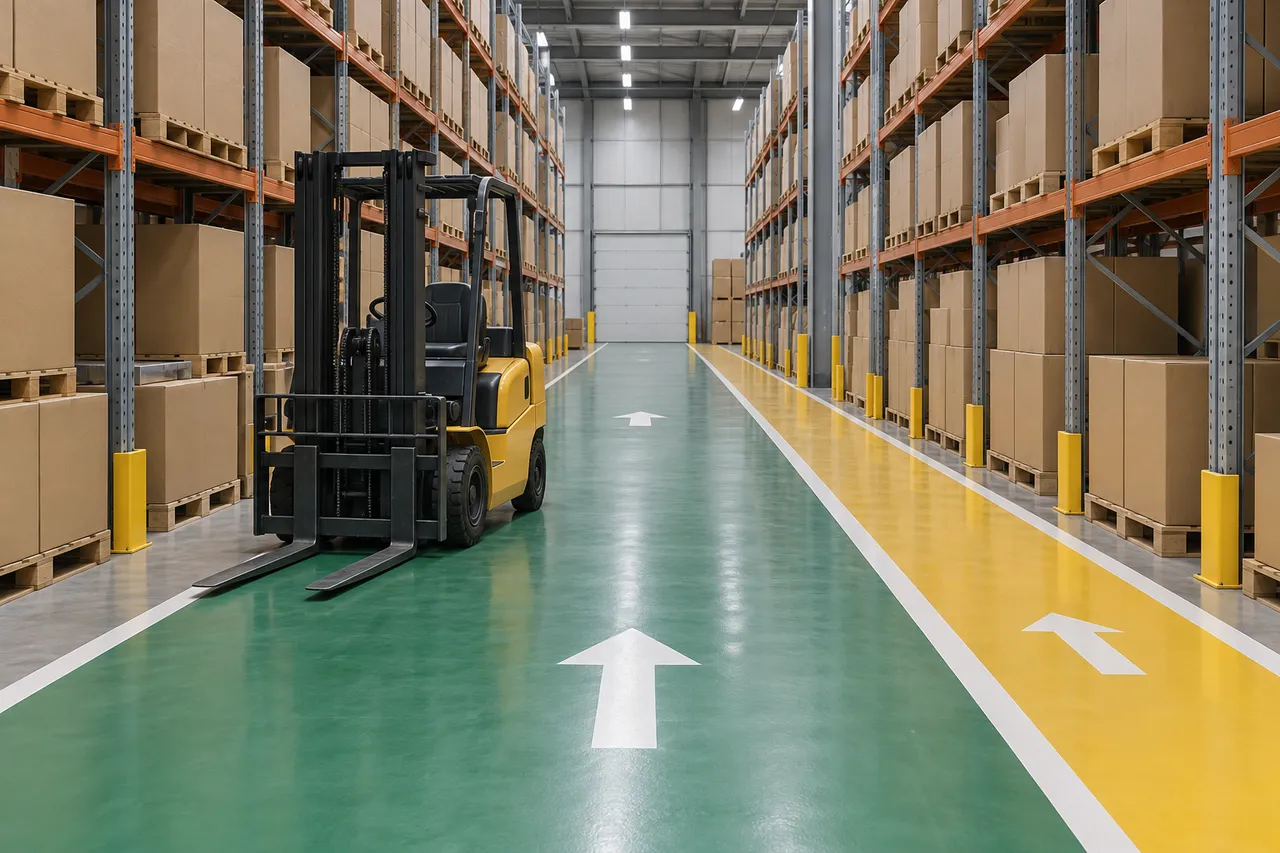
An illustrative image of forklift and pedestrian lanes marked on a warehouse floor. It was not taken at any site named in the press releases and may differ from the official standard designs.
Definition and purpose
MOEL describes workplace safety design as design that visually optimizes color, signage, traffic routes and wayfinding so that workers such as older and migrant workers can recognize hazards quickly and accurately. On industrial sites it is mainly used to separate the working areas of forklifts and other material handling machines from pedestrian walkways, and to guide fast evacuation in emergencies such as fires (MOEL press release).
The one-page sheet (OPS) attached to the release compares workplaces where walkways and forklift lanes, and emergency exits and evacuation routes, are not marked with workplaces where they are marked separately. The head of MOEL's Occupational Safety and Health Headquarters described workplace safety design as a way past the language barriers faced by migrant and day workers who find communication difficult.
13 standard designs and funding
The release lists 13 standard workplace safety designs in four groups: pedestrian safety, fire safety, hazard zones and protective equipment. The 3 pedestrian safety designs are walkways, forklift lanes and forklift intersections, and the 4 fire safety designs are fire hydrants, fire extinguishers, special extinguishers and emergency exits. The 4 hazard zone designs are hazardous material stores, openings, lifts, and welding and cutting, and the 2 protective equipment designs are PPE signs and PPE storage.
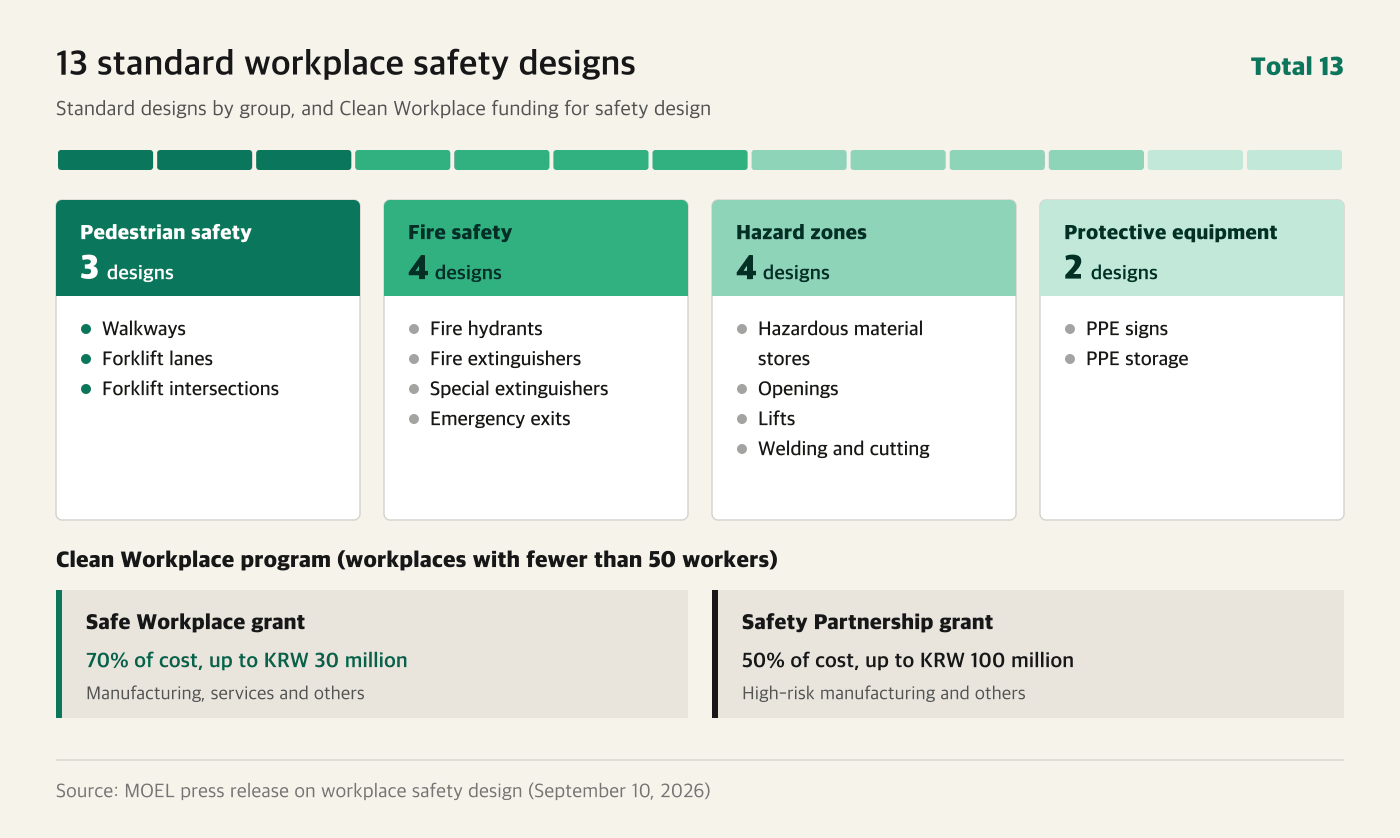
Figure 1. The 13 standard workplace safety designs by group, and funding terms. Source: MOEL press release (September 10, 2026).
KOSHA added workplace safety design improvements to its Clean Workplace program in 2025. The Safe Workplace grant covers 70% of the cost, up to KRW 30 million, for manufacturing, service and other workplaces with fewer than 50 workers. It funds floor work, which must include pedestrian safety markings, and a package of fire and explosion prevention equipment with safety design. The Safety Partnership grant covers 50% of the cost, up to KRW 100 million, for high-risk manufacturers and others with fewer than 50 workers, and funds workplace safety design improvements such as pedestrian and fire safety.
Workplaces that apply for fire and explosion prevention equipment such as extinguishers together with emergency exit safety design are selected first. Government support is also available when a principal contractor pays part of the safety design cost for an off-site subcontractor. KOSHA has simplified application documents and procedures by linking the grants with its safety management technical support and with guidance inspections by regional labor offices. Terms of the smart safety equipment subsidy are covered in the Operations Note special edition Smart Safety Equipment Subsidy 2026.
The CJ CheilJedang Busan plant
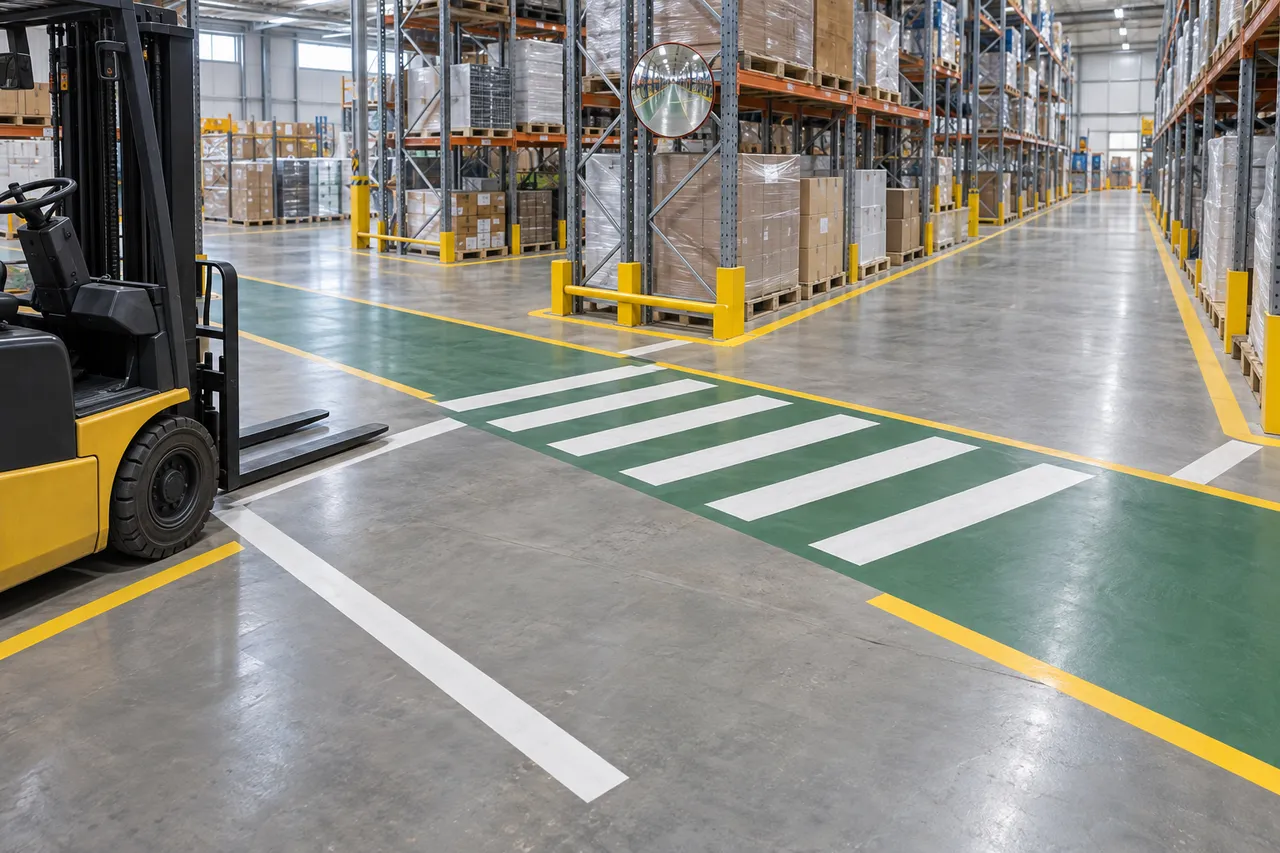
An illustrative image of crosswalk markings at a forklift intersection inside a workplace. It is not the site named in the press release.
On September 16, 2026, Minister of Employment and Labor Kim Young-hoon visited the Busan plant of CJ CheilJedang, an early adopter of workplace safety design. The site is a food manufacturing plant with about 900 regular workers. The plant separated pedestrian and forklift traffic at intersections and crosswalks, and applied safety design to the floor and emergency exits to make evacuation routes more visible (MOEL press release).
A company representative said the plant was redesigned so that anyone can recognize hazards intuitively, instead of relying on each worker's attention or on supervision. The minister said that telling workers to be careful is not enough to keep them safe, and that the work environment itself has to change.
Safety Rules on forklift traffic
Safety design does not replace legal duties. Duties on forklift lanes and pedestrian routes are set by the Rules on Occupational Safety and Health Standards (the Safety Rules). Floor markings and signs should be designed with these articles in mind.
| Article | Requirement |
|---|---|
| Art. 11 items 3 and 4 | A separate pedestrian door next to doors mainly for material handling machines; alarms such as warning lights or bells at doors with a contact hazard |
| Art. 20 item 7 | No entry under the forks, buckets or arms of vehicle-type material handling machines, or under loads they hold |
| Art. 21 | Passageway lighting of at least 75 lux |
| Art. 22 | Safe passageways kept usable, passageway markings at main points, no obstacles within 2 m of the passageway surface |
| Art. 38(1) item 2 and Art. 39 | Work plan and a designated work supervisor for work with vehicle-type material handling machines |
| Art. 98(1) | Speed limits set for the terrain and ground of the work area, and followed |
| Art. 172 | No entry where workers could be struck by the machine or its load, unless a work supervisor or signaler guides the machine |
| Art. 179 | Headlights and taillights; where collisions are possible, rear checks such as a reversing alarm and beacon or a rear sensor |
Article 39 lets employers skip the work supervisor only where no other worker can approach the work area, or where a single vehicle-type material handling machine operates with no workers nearby and no risk of collision. Article 172 bars workers from places where they could be struck by the machine or its load, with an exception only when a work supervisor or signaler guides the machine. Sections where floor markings alone do not fully separate the routes therefore need to be identified separately.
Floor colors and safety sign color standards
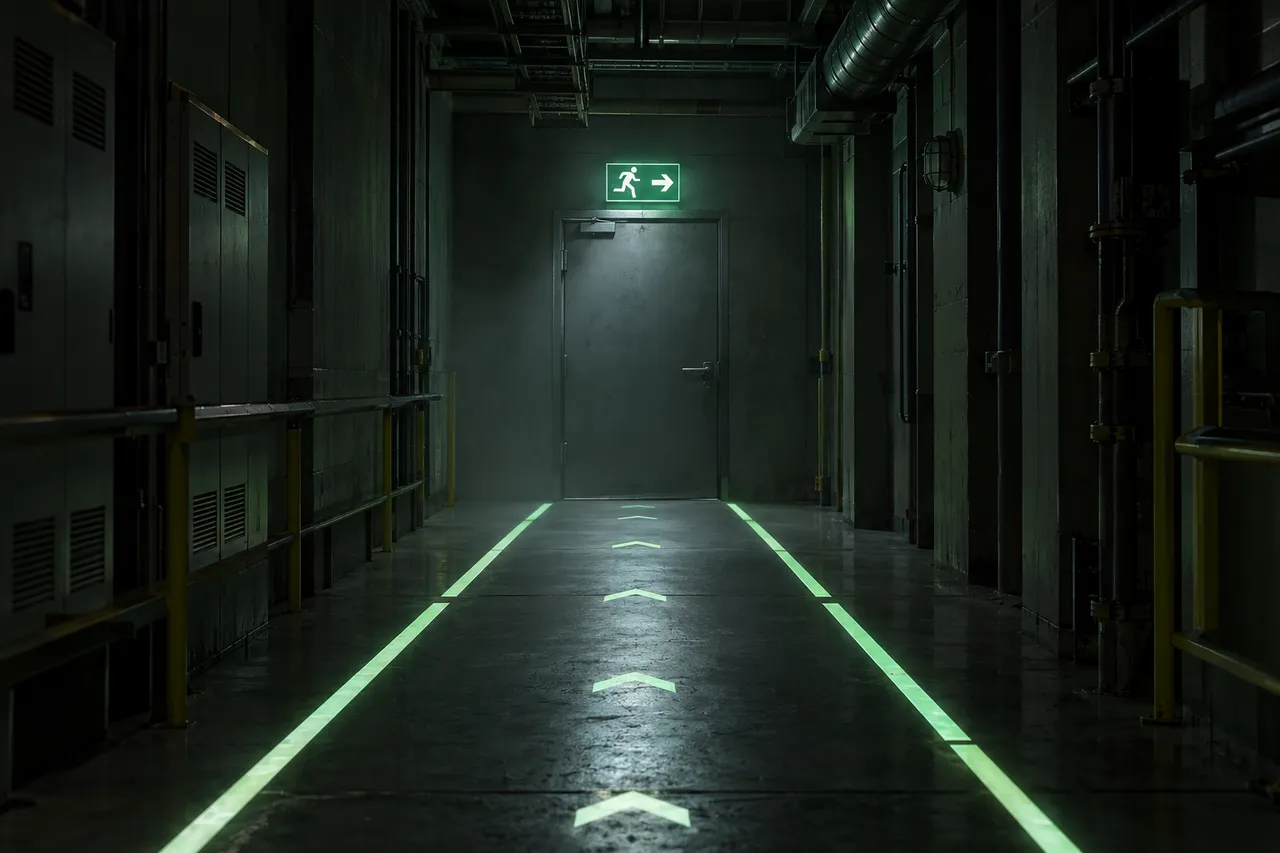
An illustrative image of an evacuation guide line in a dark corridor. It is not the emergency exit of any specific workplace.
The color standards and uses for safety and health signs are set in Annex 8 of the Enforcement Rules of the Occupational Safety and Health Act. Article 38(3) of the same rules requires employers to keep the colors of the signs they install within these standards.
| Color | Color standard | Use | Examples |
|---|---|---|---|
| Red | 7.5R 4/14 | Prohibition, warning | Stop signals, fire equipment and its location, prohibited acts, chemical hazard warnings where chemicals are handled |
| Yellow | 5Y 8.5/12 | Warning | Other hazard warnings, caution signs, machine guards |
| Blue | 2.5PB 4/10 | Instruction | Instructions for specific actions and notices of fact |
| Green | 2.5G 4/10 | Guidance | Emergency exits and shelters, traffic signs for people or vehicles |
| White | N9.5 | - | Secondary color for blue or green |
| Black | N0.5 | - | Lettering and secondary color for red or yellow |
Because green's uses include traffic signs for people or vehicles, the use categories in Annex 8 are worth checking when choosing colors for floor route markings. MOEL and KOSHA plan to work with the Korea Institute of Design Promotion to develop more standard designs, such as outdoor roads and crosswalks, and to upgrade existing designs with photoluminescent paint so they remain visible in the dark.
Forklift inspection and self-check list
On August 30, 2026, MOEL announced a focused inspection of 1,000 manufacturing sites that use forklifts, cranes and conveyors, from September 7 to 11. It said it would set a self-inspection period from August 31 to September 4 beforehand, and combine unannounced inspections by the heads of 49 regional labor offices with KOSHA patrol checks (MOEL press release). In the same release, MOEL said it had been assigning manufacturing safety monitors to check key forklift safety rules since August 2026.
Attachment 1 of the release lists three forklift deaths from 2026 as recent accident cases. On January 29 and March 8, workers were struck or run over by forklifts moving with loads, and on June 1 a worker fell while installing panels standing on a forklift's forks. Of the 13 items on the forklift self-check list in the same attachment, those on traffic routes cover separate doors, lighting and width of forklift routes, speed limit signs, no entry to hazard zones, and a work supervisor or signaler where routes are not separated. The list names separating the routes of people and forklifts as a rule that must always be followed during work.
Stricter inspections of repeat accidents in manufacturing are covered in the Field Guide special edition Korea's 2026 Crackdown on Repeat Factory Accidents.
Field checklist
- Check that a separate pedestrian door sits next to each forklift door, and that doors with a contact hazard have alarms such as warning lights or bells.
- Compare floor plans with the site to confirm that forklift lane, walkway and intersection markings match actual forklift routes, including turning and reversing areas.
- Check that passageway lighting is at least 75 lux and that there are no obstacles within 2 m of the passageway surface.
- List sections where routes are not fully separated, and check each against the work plan for a work supervisor or signaler.
- Check that speed limits are set and signposted, and that operators follow them.
- Before work, check that forklift headlights, taillights, reversing alarms, beacons or rear sensors work.
- Check that safety sign colors have not faded below the color standards, and repair worn floor markings regularly.
- Check that emergency exit and evacuation route markings stay visible during a power cut or in smoke.
- Workplaces with fewer than 50 workers can check the Clean Workplace eligibility and funding rates on the KOSHA safety portal.
Summary
Workplace safety design separates forklift and pedestrian routes with color and signage so that hazards are recognized intuitively, and MOEL and KOSHA support it with 13 standard designs and the Clean Workplace program. Floor markings need to be reviewed together with the Safety Rules on separate doors, passageway markings and contact prevention, so routes should be checked against the articles before any painting starts. Funding terms are on the KOSHA safety portal (portal.kosha.or.kr), and the current text of the cited articles is on the National Law Information Center (law.go.kr).
Energy isolation for maintenance and cleaning is covered in Operations Note part 4, LOTO for Maintenance and Cleaning: Restart Checks.
Official sources
- MOEL press release, Prevent industrial accidents with workplace safety design (September 10, 2026)
- MOEL press release, Minister visits a site that adopted workplace safety design (September 16, 2026)
- MOEL press release, Focused inspection of forklifts, cranes and conveyors (August 30, 2026)
- National Law Information Center, Rules on Occupational Safety and Health Standards
- National Law Information Center, Enforcement Rules of the Occupational Safety and Health Act
- KOSHA, Industrial Safety Portal