Korea's Winter Fire and Explosion Inspections
Updated
Korea's labor ministry will inspect fire and explosion risk workplaces from November 2 to 13, 2026, after a self-check period from October 19 to 30. Fire and explosion deaths through the second quarter of 2026 were 32, twice the figure for the same period of 2025. The focused on-site inspections by the Ministry of Employment and Labor (MOEL) concentrate on four measures: preventing sparks and spatter from scattering, measuring gas concentrations and ventilating, suppressing and removing static electricity, and keeping fire-fighting equipment and evacuation routes ready.
Current as of October 19, 2026.
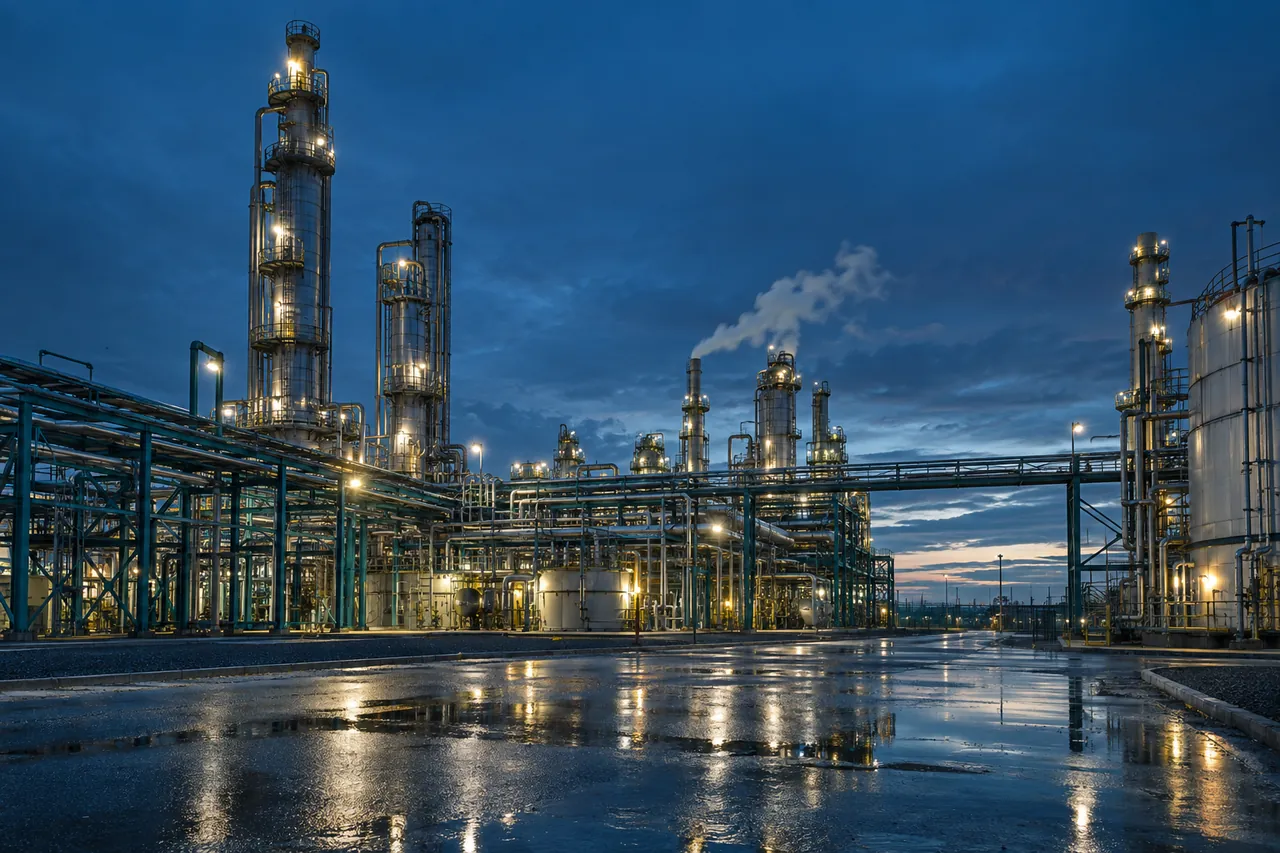
Illustrative image
Inspection overview
MOEL announced the fire and explosion prevention inspections in a press release on October 18, 2026. From Monday, October 19 to Friday, October 30, workplaces check and fix hazards themselves using a self-check sheet and the safety rules sheet (OPS) attached to the release. From Monday, November 2 to Friday, November 13, inspectors then confirm on site whether the hazards were actually fixed and the safety measures are in place. The heads of the 49 regional labor offices will also make unannounced site visits, and the Korea Occupational Safety and Health Agency (KOSHA) will check fire and explosion hazards during its patrol inspections and technical guidance.
| Stage | Period | Main content |
|---|---|---|
| Self-check | October 19-30, 2026 | Workplaces check and fix hazards with the self-check sheet and OPS |
| Focused inspection | November 2-13, 2026 | Inspectors confirm improvements and safety measures on site |
The inspections focus on spark and spatter prevention and fire watchers during fire-risk work, gas concentration measurement and ventilation, static control, and fire-fighting equipment and evacuation routes. Violations found will draw an immediate administrative fine and corrective action, and MOEL plans judicial action against workplaces that do not carry out correction orders. In December, MOEL also plans a focused inspection of outdoor workers' cold-weather safety, checking five basic rules: warm clothing, a warm shelter (rest), warm water, adjusted working hours and calling 119.
Fire and explosion deaths
According to the release, deaths subject to accident investigation through the second quarter of 2026 fell from a year earlier, but fire and explosion deaths rose from 16 to 32, an increase of 16 (100%). In manufacturing, fire and explosion deaths rose from 4 to 9, an increase of 5 (125%). The first-half trend in work deaths and in fires and explosions is covered in Korea's H1 2026 Work Deaths: Falls Down, Fires Up.
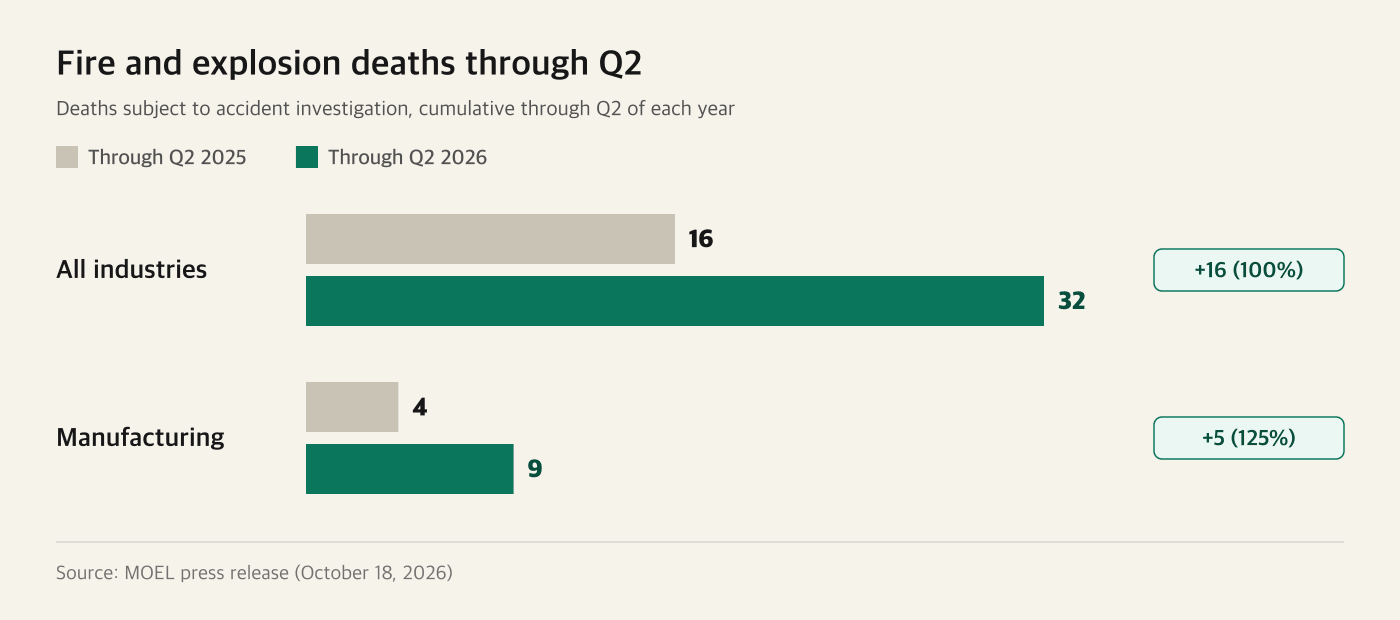
Figure 1. Fire and explosion deaths through the second quarter. Source: MOEL (October 18, 2026).
| Date | Location and industry | Type | Deaths |
|---|---|---|---|
| March 2026 | Auto parts plant, Daejeon | Fire | 14 |
| June 2026 | Defense company, Daejeon | Explosion | 5 |
| August 2026 | Manufacturing plant, Cheonan, South Chungcheong | Fire | 3 |
The safety sheet attached to the release explains that a fire or explosion starts the moment a combustible meets oxygen and an ignition source. It lists ignition sources such as sparks and spatter from welding and cutting, electrical sparks, static electricity, open flames and sparks from metal friction, and combustibles such as flammable liquids including oil and thinner, flammable gases including LPG, wood, paper and urethane. It gives three cases: a fire from welding spatter at a building construction site on February 14, 2025; a fire on March 4, 2026 when sparks from welding on the vapor piping on top of a tanker truck ignited the vapor; and a fire on January 8, 2026 from a spark, presumed to be static, while toluene was being poured into a mixing vessel.
Self-check sheet
The self-check sheet has 12 items, three in each of four categories, with separate columns for the supervisor and the worker to tick. Each item names the provision it rests on, and workplaces may add items that reflect their own conditions, such as near misses and risk assessment results.
| Category | Items checked | Provisions (Occupational Safety and Health Standards Rules) |
|---|---|---|
| Flammable and combustible materials | Suppressing and removing static, measuring gas concentration and ventilating, blocking and isolating ignition sources | Articles 225, 231, 232, 236, 239, 241, 242, 278, 296, 311, 325 |
| Fire-risk work | Removing flammable and combustible materials before work, spark and spatter prevention, appointing and posting a fire watcher | Articles 240, 241, 241-2 |
| Chemical equipment | Pre-use checks of equipment and safety devices, maintaining instruments, alarms and emergency shut-off devices, installing safety valves and testing them regularly | Articles 261, 262, 263, 273, 274, 275, 277 |
| Emergency measures | Installing and maintaining evacuation facilities, installing fire-fighting equipment, safety training and evacuation drills | Articles 17, 18, 243, 279; Occupational Safety and Health Act Article 29 |
Article 277, behind the chemical equipment items, requires the safety inspection items of chemical equipment to be checked before use when the equipment is used for the first time, after it has been dismantled, modified or repaired, and when it is used again after a month or more out of use. When its use changes, the employer must check for substances inside that could cause an explosion or fire, the function of safety valves and emergency shut-off devices, and the function of cooling, heating, stirring, compression, measuring and control devices.
Rules for fire-risk work
Article 236(2) of the Occupational Safety and Health Standards Rules defines fire-risk work as work that uses fire, such as welding, cutting and heating metal, and other work that may produce sparks, such as dry grinding with a grinding wheel. During fire-risk work, materials such as synthetic fibers, synthetic resins, paper and flammable liquids must be stored separately in a place without fire risk, and only the amount needed for the job may stay in the work area. Under Article 240, fire-risk work on piping, tanks or drums that may contain hazardous substances, flammable oils or flammable solids is allowed only after measures such as removing those contents first.
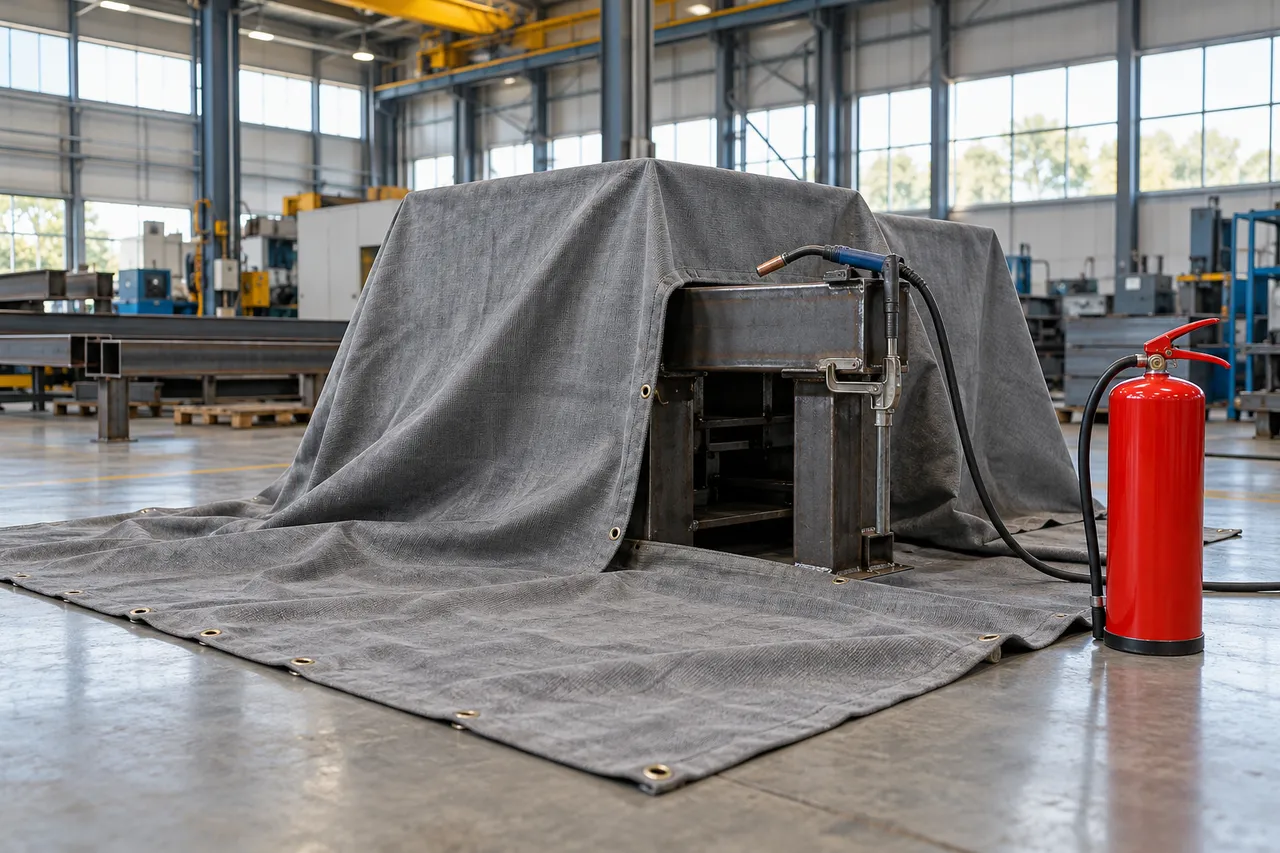
Article 241(2) sets six requirements for fire-risk work where combustibles are present: preparing the work and setting a work procedure; knowing what hazardous substances are used and stored in the workplace; protecting nearby combustibles and keeping fire extinguishing equipment at hand; preventing sparks and spatter from scattering with welding spatter covers, welding blankets and similar means; ventilating so that no flammable vapor or gas remains; and emergency measures such as fire prevention and evacuation training. Welding blankets must carry a performance certification under Article 40(1) of the Act on the Installation and Management of Fire-Fighting Systems, a requirement in force since March 2, 2026.
Illustrative image
The employer must confirm these points and put spatter prevention in place before work starts, and must post in writing at the work site, from start to finish, the work content, date and time, and the safety checks and measures taken; this posting may be skipped where fire-risk work is routinely repeated at the same place. Oxygen must not be used for ventilation in places with poor airflow.
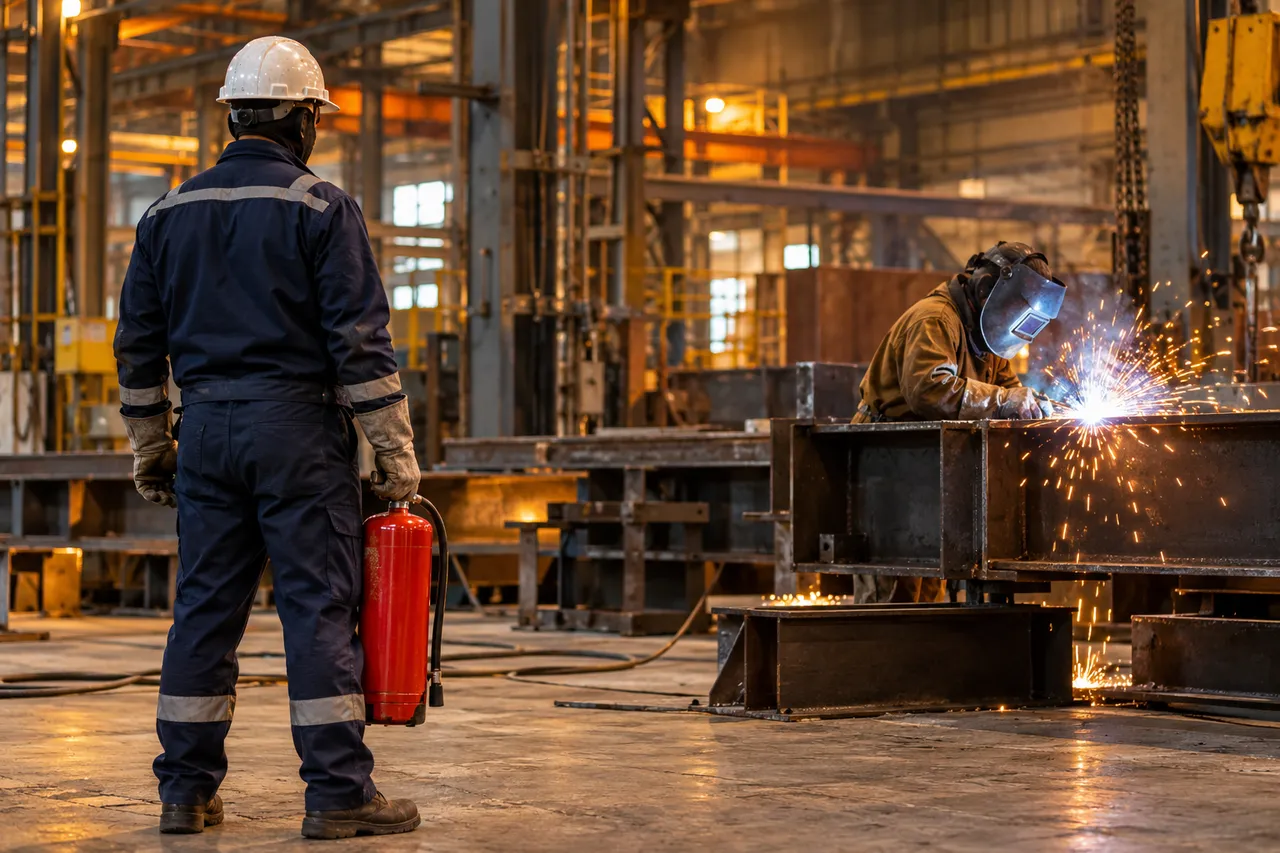
Article 241-2 sets when a fire watcher must be posted for welding and cutting: where combustibles are in the building structure itself or its interior within an 11-meter working radius; where combustibles lie beneath the floor within an 11-meter radius, more than 11 meters away but easily ignited by sparks; and where combustibles sit against the far side of a metal partition, wall, ceiling or roof and could ignite through heat conduction or radiation. A fire watcher may be omitted where welding or cutting is routinely repeated at the same place and alarm equipment, fire-fighting equipment or extinguishers are in place. The fire watcher checks for combustibles and whether the gas detection and alarm devices work, and leads evacuation in a fire; the employer must provide the fire watcher with evacuation equipment such as a loudspeaker, a portable light and a fire escape mask.
Gas measurement and static control
Article 232 requires ventilation equipment such as ventilating and exhaust fans, and gas detection and alarm devices, wherever flammable liquid vapor, flammable gas or flammable solids could cause an explosion or fire. When flammable liquids are used with a spray gun for cleaning or painting in an enclosed space, Article 231(2) requires enough ventilation that the airborne concentration does not exceed 25 percent of the lower flammable limit. In underground workplaces where flammable gas may arise, Article 296 requires a designated person to measure gas concentration before work each day and when a leak is suspected, among other times, and every four hours during long work. If the concentration reaches 25 percent of the lower flammable limit, workers must be evacuated at once and machines and tools that could ignite the gas must be stopped.
Illustrative image
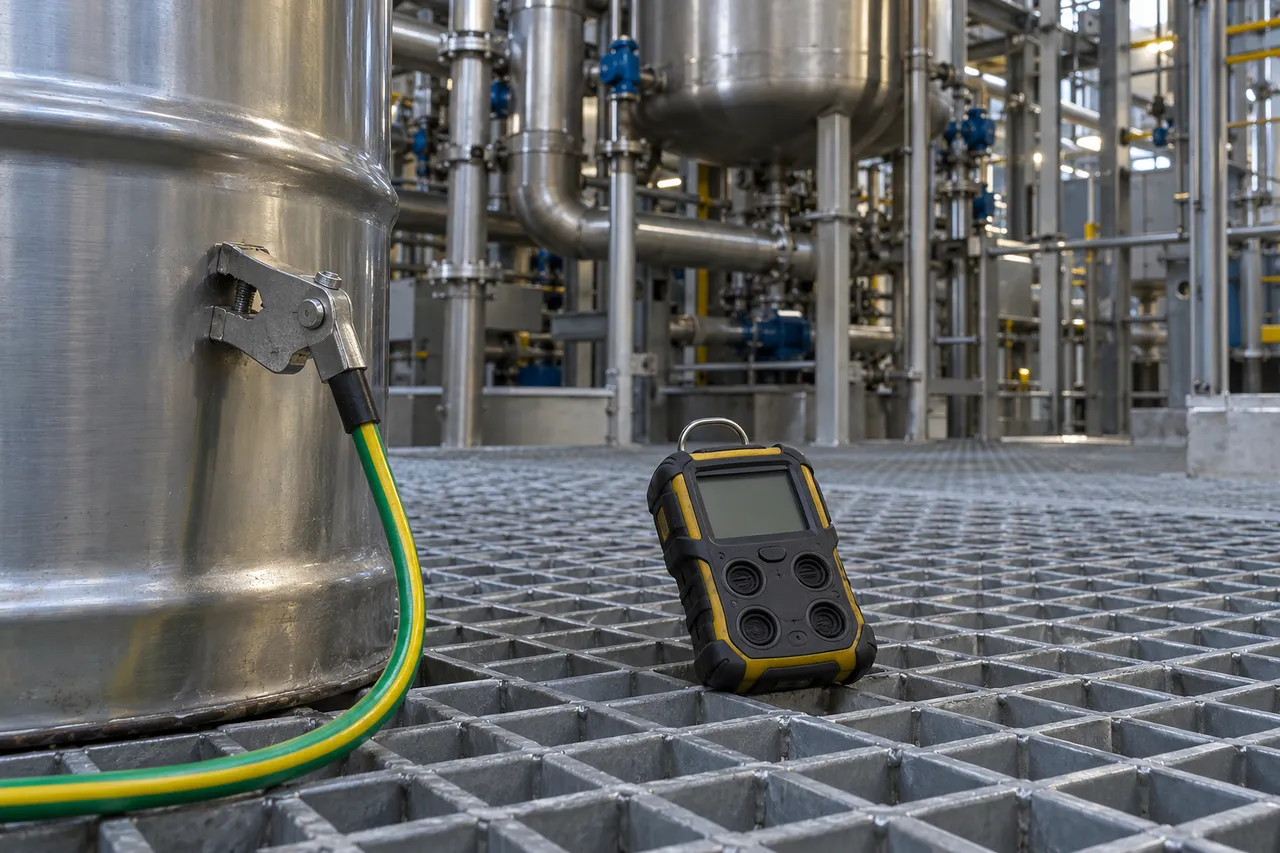
Article 325(1) covers ten types of equipment, including equipment that fills tanker trucks, tank cars and drums with hazardous substances and equipment that handles paints and adhesives containing flammable liquids. Where static could cause a fire or explosion, it must be suppressed or removed by grounding, conductive materials, humidification, static eliminators and similar means. Article 325(2) requires measures such as antistatic safety shoes, antistatic clothing, static removal tools or a conductive floor where static charged on the body poses a risk. Oxygen and toxic gas measurement procedures are covered in Confined Space Gas Testing Rules and Records.
Fire-fighting equipment and evacuation
Under Article 243, buildings, places with chemical equipment or hazardous-substance drying equipment, and places handling flammable oils need fire-fighting equipment suited to their size, area and the substances handled. Article 17 requires workplaces that make or handle hazardous substances to have at least one emergency exit in addition to the entrance. It must be at least 3 meters from the entrance, and the horizontal distance from any part of the workplace to an emergency exit or entrance must be 50 meters or less. The exit must be at least 0.75 meters wide and 1.5 meters high, with a door that opens in the direction of escape.
Article 18 requires emergency exits, emergency passages and emergency equipment to be kept easy to use. Under Article 279, when there is an imminent danger of an industrial accident from an explosion or fire, the employer must stop work at once, move workers to a safe place, and keep unauthorized people out until it is confirmed that workers are no longer at risk.
Field checklist
- List fire-risk work such as welding, cutting and grinding at the site, and check the procedure and spatter prevention for each job.
- Confirm that only the amount needed for the job of combustibles and flammable liquids remains around fire-risk work areas.
- Confirm that welding blankets carry the performance certification required under the fire-fighting systems act.
- Use the 11-meter working radius to identify jobs that need a fire watcher, and record the evacuation smoke protection issued to fire watchers.
- Check that the work content, date and time, and safety checks of fire-risk work are posted in writing at the work site.
- Check that ventilation and gas detection and alarm devices work wherever flammable vapor or gas is present.
- Check grounding and static removal on equipment with static risk, such as tanker trucks, drums, and paint and adhesive equipment.
- Before using chemical equipment that has been idle for a month or more, or dismantled, modified or repaired, check the equipment and its safety devices for faults.
- Confirm the fire-fighting equipment in place, check emergency exits and passages for obstructions, and schedule evacuation drills.
- Fix items found lacking in the self-check before the focused inspections start on November 2, and keep records of the fixes.
Summary
With fire and explosion deaths through the second quarter of 2026 at twice the level of a year earlier, MOEL is using October self-checks and November focused inspections to confirm how workplaces control sparks and spatter, gas concentrations, static, fire-fighting equipment and evacuation routes. Workplaces should have supervisors and workers go through the 12 items of the self-check sheet by October 30 and fix any gaps before November 2. The underlying provisions are available from the National Law Information Center (law.go.kr).
Inspection findings at workplaces that handle chemicals are covered in the Workplace Safety Field Guide Semiconductor Plant Inspection: 338 Violations.