Serious Accidents Punishment Act: 37 Sites Named
Korea's labor ministry named 37 workplaces with final Serious Accidents Punishment Act convictions on October 15, 2026, bringing the total to 81.
Current as of November 1, 2026.
Illustrative image
Serious Accidents Punishment Act workplaces named in 2026
On October 15, 2026, Korea's Ministry of Employment and Labor (MOEL) published the serious industrial accidents of 37 workplaces under the Serious Accidents Punishment Act, in the Official Gazette as MOEL Notice No. 2026-475 and on the MOEL website. The list covers workplaces whose sentences became final and were notified to the ministry in the first half of 2026. MOEL has published such lists every half year since September 2023, and the total now stands at 81 workplaces.
| Sentences final in | Workplaces |
|---|---|
| First and second half of 2023 | 3 |
| First and second half of 2024 | 12 |
| First and second half of 2025 | 29 |
| First half of 2026 | 37 |
| Total | 81 |
The 37 workplaces had 39 responsible executives, including 2 from subcontractors alongside the principal contractors. One received a prison term, 35 received suspended prison sentences, 1 received a suspended prison sentence and a fine, and 2 received fines. According to MOEL's press release, the list includes the heaviest sentence since the Act took effect, a three-year prison term, and the first case in which an executive was arrested and indicted, which ended in a final sentence of one year and six months in prison, suspended for three years.
The accidents at the 37 workplaces in MOEL Notice No. 2026-475 killed 38 workers and injured 4. They occurred between March 17, 2022 and July 21, 2025: 8 workplaces in 2022, 5 in 2023, 19 in 2024 and 5 in 2025. On February 15, 2024, at a mechanical works project in a school restroom in Pocheon, Gyeonggi Province, a worker fell from a mobile scaffold 1.2 meters high. The press release says the worker fell while working without basic protective equipment, resumed work without any further measures, and died the next day. The notice gives the cause as the lack of guardrails on the mobile scaffold and the failure to supply hard hats and check that they were worn.
Legal basis and procedure for publishing serious industrial accidents
Publication of serious industrial accidents rests on Article 13 of the Serious Accidents Punishment Act and Article 12 of its Enforcement Decree. Article 2, item 2 of the Act defines a serious industrial accident as an industrial accident in which at least 1 person dies, at least 2 people in the same accident need treatment for 6 months or more, or at least 3 people develop acute poisoning or another occupational disease from the same hazard within 1 year. Under Article 13(1), the Minister of Employment and Labor may publish the name of the workplace, the date, time and place, and the content and cause of a serious industrial accident caused by a breach of the safety and health duties in Article 4.
Under Article 12(1) of the Decree, publication covers workplaces whose final sentence has been notified under Article 12 of the Act, which requires the Minister of Justice to notify the relevant agencies once a sentence under the Act becomes final. Article 12(2) of the Decree sets six items: the title of the publication, the name of the workplace, the date, time and place of the accident, the number of people affected, the content and cause of the accident (including the breaches by the employer or responsible executive), and whether the workplace had any serious industrial accident in the last 5 years.
Illustrative image
Under Article 12(3) of the Decree, before publishing, the minister must notify the employer or responsible executive of the planned content and give them at least 30 days to submit explanatory material or state their views. Publication is made in the Official Gazette and on the website of MOEL or the Korea Occupational Safety and Health Agency (KOSHA), and stays on the website for 1 year. After the objection procedure, MOEL publishes each half year according to when the sentences became final.
| Sentence final and notified | Publication |
|---|---|
| January to June | Second half of the same year |
| July to December | First half of the following year |
Sentences and fines in the 81 final cases
From January 27, 2022, when the Serious Accidents Punishment Act took effect, to June 30, 2026, 81 workplaces had final, notified judgments, and 85 responsible executives were sentenced. There are more executives than workplaces because at 4 workplaces both the principal contractor and the subcontractor were sentenced. Article 6(1) of the Act punishes an employer or responsible executive whose breach of the safety and health duties leads to a fatal serious industrial accident with at least 1 year in prison or a fine of up to KRW 1 billion, and Article 7 fines the corporation up to KRW 5 billion.
| Category | Statutory penalty for a death | Final sentences in the 81 cases |
|---|---|---|
| Executive, prison term | At least 1 year in prison | 3 people, 1 to 3 years |
| Executive, suspended sentence | At least 1 year in prison | 77 people, 6 months to 2 years, suspended for 1 to 3 years |
| Executive, suspended sentence and fine | Prison and fine may be combined | 2 people, 1 year to 1 year 6 months, suspended for 2 years, fines of KRW 10 million to 15 million |
| Executive, fine | Fine up to KRW 1 billion | 3 people, KRW 10 million to 30 million |
| Corporation, fine | Fine up to KRW 5 billion | Minimum KRW 10 million, maximum KRW 2 billion, average KRW 98 million |
Article 6(2) of the Act sets up to 7 years in prison or a fine of up to KRW 100 million for serious industrial accidents that cause injuries or occupational disease. Article 6(3) raises the penalty by up to half for anyone who commits the same offence again within 5 years of a final sentence.
Decree Article 4 duties breached
According to MOEL's press release, the provision most often breached across the 81 published workplaces was Article 4, item 3 of the Enforcement Decree of the Serious Accidents Punishment Act, on checking the identification and improvement of hazards, breached at 75 workplaces (92.6%). Next came item 5, on measures that let safety and health managers carry out their duties properly, breached at 62 workplaces (76.5%). Each workplace breached 3.6 provisions on average.
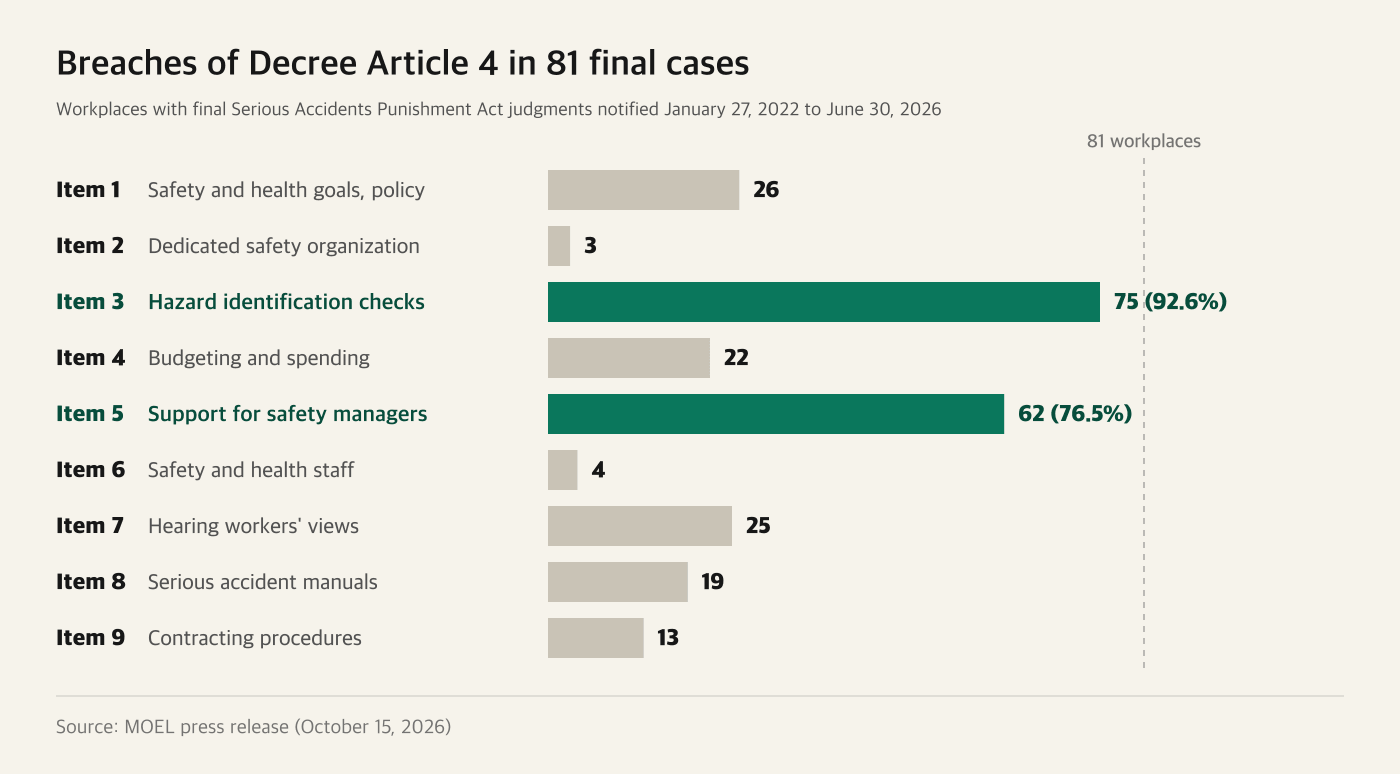
Figure 1. Breaches of each item of Decree Article 4 in the 81 final Serious Accidents Punishment Act cases. Source: MOEL (October 15, 2026).
Article 4, item 3 of the Decree requires a procedure to identify and improve hazards specific to the workplace, and a check at least once every half year that hazards are identified and improved under that procedure. Its proviso treats the check as done where a risk assessment procedure under Article 36 of the Occupational Safety and Health Act is in place and the risk assessment is carried out, directly or by others, with the results reported. The risk assessment procedure is covered in Korean Risk Assessment in 5 Steps: 2026 Guide.
Article 4, item 5 of the Decree requires giving the safety and health officer, supervisors and the general safety and health officer the authority and budget they need, setting criteria for whether they carry out their duties properly, and evaluating them at least once every half year. The other items were breached as follows: item 1, safety and health goals and management policy, 26 workplaces; item 7, hearing workers' views, 25; item 4, budgeting and spending, 22; item 8, manuals for serious accidents, 19; and item 9, safety and health procedures for contracting, 13. Article 5(2), item 1 of the Decree, on checking compliance with safety and health laws, was breached at 18 workplaces. The nine duties in Decree Article 4 and how the first conviction under the Act weighed them are covered in Serious Accidents Punishment Act: First Conviction.
Caught-in accidents during machine cleaning and operation
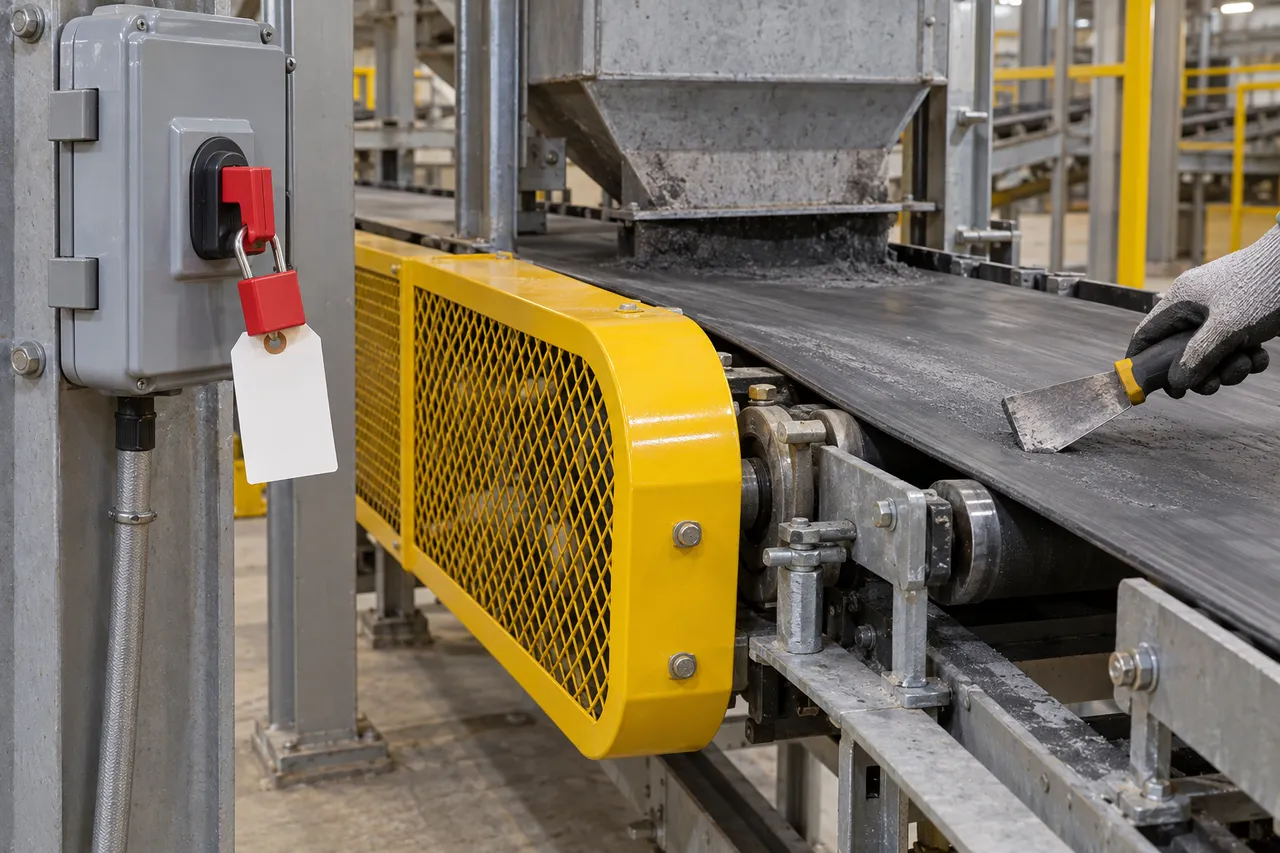
The 37 workplaces in MOEL Notice No. 2026-475 include several fatal accidents in which workers were caught while cleaning or clearing debris from machines that had not been stopped. The direct causes the notice gives are missing machine safeguards: stopping the machine, power cut-off devices, locks on start devices, covers and guards.
| Date of accident | Equipment | Task | Cause given in the notice |
|---|---|---|---|
| May 26, 2022 | Blow moulding machine | Removing scrap with the guard door open | Machine not stopped while the guard was not working |
| July 16, 2022 | Resin film rollers | Removing debris by hand from moving film | No power cut-off device operable from the work position; machine not stopped for cleaning |
| March 7, 2024 | Automatic cutter | Cutting aluminium | No power cut-off device operable from the work position |
| April 20, 2024 | Crusher | Cleaning the inside | Power not cut off; no lock or sign on the start device |
| June 15, 2024 | Cubing machine (automatic brick stacker) | Adjusting bricks under the running machine | No automatic stop on opening and no guard fence |
| January 25, 2025 | Belt conveyor | Removing frozen soil from the belt | No cover on the rotating shaft; machine not stopped for cleaning |
Illustrative image
For all six accidents the notice cites the chief executive's failure to carry out the hazard identification and improvement procedure in Article 4, item 3 of the Decree. The January 25, 2025 accident at a site in Wonju, Gangwon Province, happened while a worker was removing frozen soil from a conveyor belt. Energy isolation and restart checks before maintenance and cleaning are covered in LOTO for Maintenance and Cleaning: Restart Checks.
Field checklist
- Check that the hazard identification and improvement procedure exists in writing and that checks at least once every half year are recorded.
- Where risk assessment stands in for the item 3 check, keep records showing that the responsible executive received the risk assessment results.
- Record the authority and budget given to the safety and health officer, supervisors and the general safety and health officer, and the results of their half-yearly evaluations.
- Check both in the work procedure and on the floor that machines are stopped before cleaning, debris removal and maintenance.
- Check that power cut-off devices can be operated from the work position.
- Check that start devices are locked or tagged during internal cleaning so that no one else can start the machine.
- Check that rotating conveyor shafts are covered and that interlocked stops on guard doors and guard fences are installed and working.
- Before work starts, check guardrails on mobile scaffolds and that hard hats are supplied and worn.
Summary
Publication under the Serious Accidents Punishment Act makes public, in the Official Gazette and on the MOEL website, the name of each workplace with a final sentence, the cause of the accident and the provisions the executive breached, and 81 workplaces had been named as of October 15, 2026. Workplaces whose sentences become final and are notified between July and December 2026 are due to be published in the first half of 2027. Sites should start by checking their half-yearly records for items 3 and 5 of Decree Article 4, the two duties breached most often. The underlying provisions are available from the National Law Information Center (law.go.kr).
Accident causes in cases with final rulings are covered in the Workplace Safety Field Guide Korea's Accident Investigation Reports Go Public.
Official sources
- MOEL, press release on publishing 37 workplaces with final serious industrial accident sentences (October 15, 2026)
- MOEL, Notice No. 2026-475, publication of serious industrial accidents for the first half of 2026 (October 15, 2026)
- National Law Information Center, Serious Accidents Punishment Act
- National Law Information Center, Enforcement Decree of the Serious Accidents Punishment Act