
Korea's M.AX Manufacturing AI Push: Where Factories Start
Industry Operations Note special edition: Korea's manufacturing AI push (M.AX)
Korea's manufacturing AI transformation policy, M.AX, picked up pace in the second half of 2026. The Ministry of Trade, Industry and Resources aims to reach 220 AI factories by year-end, and at a September 21 hackathon, manufacturing CEOs discussed AI vision inspection, veteran workers' tacit knowledge, and predictive maintenance as first projects for their plants.
This article is based on Ministry of Trade, Industry and Resources announcements, the Korea.kr policy briefing, and related press coverage as of September 26, 2026. The 2027 budget figures are the government's proposal, not yet reviewed by the National Assembly.
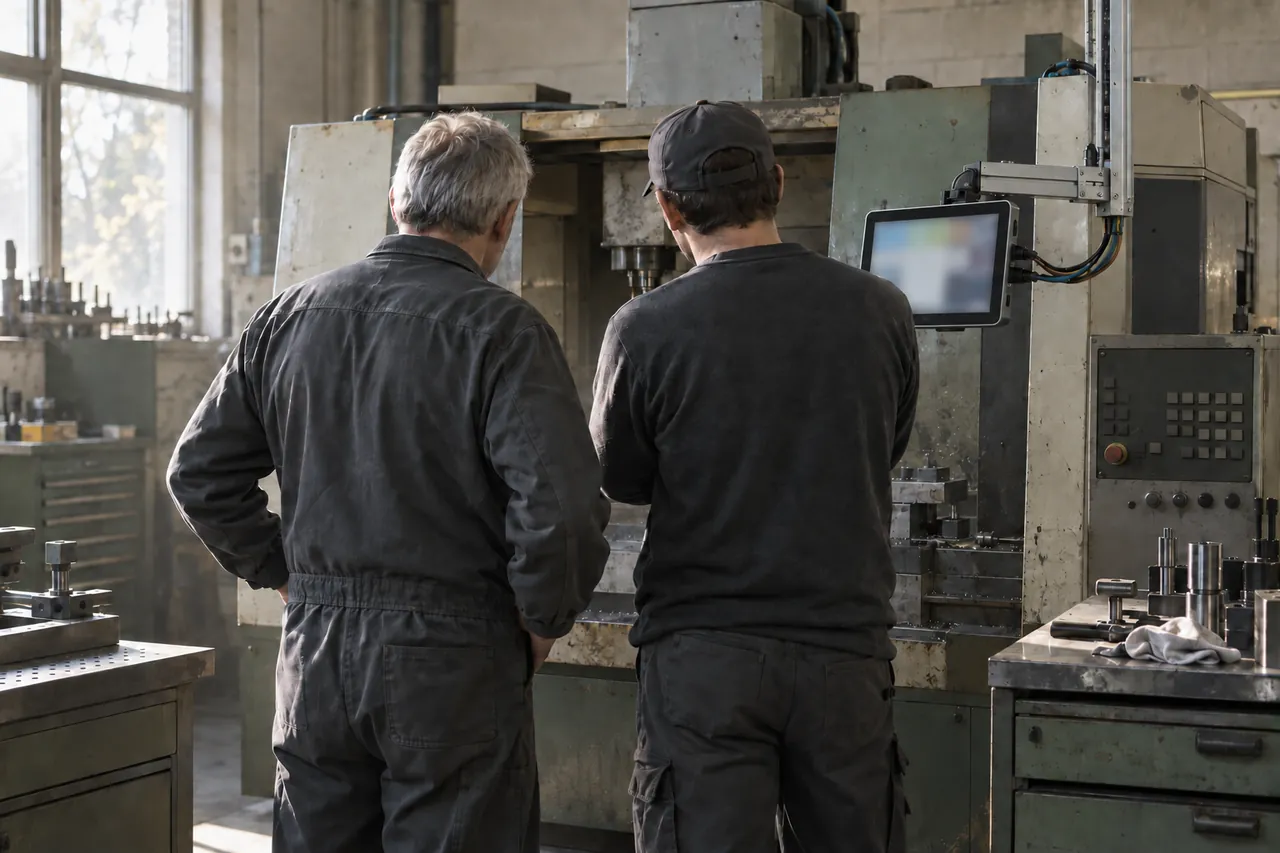
An illustrative image of manufacturing AI transformation. The equipment and scene do not depict any specific workplace or government program.
What M.AX is
M.AX stands for Manufacturing AI Transformation. It is a strategy to apply AI across the whole business, not only production processes but also product and service development, production planning, and supply chain and inventory management (policy briefing).
The M.AX Alliance, a public-private body, has grown from about 1,000 member organizations at its September 2025 launch to about 1,500. It runs 11 working groups, including AI factories, AI semiconductors, AI robotics, and industrial-complex AX.
The August and September announcements
| Date | Event | Key points |
|---|---|---|
| 2026-08-04 | Second-half work plan | 220 AI factories cumulative by year-end (50 in the second half), 500 by 2030 |
| 2026-09-01 | 2027 budget proposal | KRW 13.2573 trillion, up 40.5% year on year (government proposal) |
| 2026-09-11 | First M.AX regional conference | Changwon, about 200 attendees, briefing on new programs |
| 2026-09-21 | M.AX CEO hackathon | Sejong, about 100 participants, 10 teams defining AX projects |
Sources: Ministry of Trade, Industry and Resources (2026-08-04, 2026-09-01), Korea.kr policy briefing, press coverage (2026-09-11, 2026-09-21)
August 4: the second-half work plan
The ministry presented its second-half work plan at a briefing held at the Cheong Wa Dae guest house on August 4. It plans to bring the cumulative number of manufacturing processes converted into AI factories to 220 by year-end and to capture veteran workers' tacit knowledge as data at 30 manufacturing sites to build AI models. The 2030 targets are 500 AI factories and seven regional M.AX clusters.
The government also reported that an analysis of 42 sites in its AI factory lead projects showed average productivity gains of 30.1% and an average 15.5% drop in defect rates. These are government figures based on those 42 sites, not on all of the roughly 170 supported sites. Read them as a reference point, not as the result your own plant should expect.
September 1: the 2027 budget proposal
The ministry's 2027 budget proposal is KRW 13.2573 trillion, KRW 3.8231 trillion (40.5%) above the 2026 budget of KRW 9.4342 trillion and the largest on record. Including the Future Response Fund, it totals KRW 14.1691 trillion (ministry press release).
After restructuring about KRW 1.5 trillion of existing spending, the ministry concentrated funds on manufacturing AI, mega-projects, and resource security. Press reports say the proposal includes a manufacturing AI foundation model and manufacturing data programs; check the official documents for line-item amounts. The National Assembly may still change the totals.
September 11: the Changwon regional conference
The first M.AX regional outreach conference took place in Changwon, South Gyeongsang Province, with about 200 people from local manufacturers, AI companies, universities, and research institutes. It included one-on-one consultations, company case presentations, and a briefing on new M.AX programs in the 2027 budget proposal. Sessions in North Chungcheong, North Gyeongsang, and Gwangju-South Jeolla are scheduled to follow.
The first projects CEOs chose
The M.AX CEO hackathon in Sejong on September 21 brought together about 100 people, including about 50 CEOs of manufacturers in industrial complexes. CEOs answered the question "What should our plant change with AI first?" themselves, then worked with AI experts in 10 teams to turn their answers into projects (EBN).
The projects discussed covered tacit-knowledge AX, AI vision inspection to replace manual visual checks, predictive maintenance that detects early signs of equipment trouble, and physical AI and autonomous manufacturing in sectors such as shipbuilding. Long-standing shop-floor problems such as equipment failures and a shortage of skilled workers came first. In his keynote, Minister Kim Jung-kwan presented three A's for CEOs, Adapt, Adept, and Adopt, framing AX as redesigning how work gets done rather than buying a solution.
Reports also said strong projects may be linked to government programs for follow-up pilots. The details should become clear in later program notices.
What the three projects share: data
Vision inspection, tacit knowledge, and predictive maintenance point in different directions but start in the same place. Vision inspection needs images of good and defective parts. Tacit knowledge needs records of what veteran workers looked at and when they made a call. Predictive maintenance needs equipment condition signals and failure history.
Program budgets and schedules are not final yet, but collecting data can start now. For an equipment failure project, first decide which failures you need to know about and how early; that decision sets the sensors and collection intervals.
What to check first at your plant
- Pick one recurring shop-floor problem. Look at where losses are largest: defect inspection, equipment failures, or processes that depend on a few veterans.
- Check whether the data for that problem is being collected today. If records live only on paper or in personal notes, decide how to store them first.
- For equipment failure projects, organize maintenance and failure records by machine.
- Capture veteran workers' decision criteria through interviews or work logs, ideally before they retire or move on.
- If AI will inform decisions on the floor, confirm the applicable rules and who is accountable before you start.
- Track the regional conference schedule and the program notices that follow the final budget.
Summary
M.AX has moved from plans to concrete projects through the second-half work plan, a record budget proposal, the regional conference, and the CEO hackathon. The 2027 budget becomes final only after National Assembly review, so defining your plant's first project and the data it needs beforehand lets you evaluate program notices as soon as they appear. The official announcements are on the Korea.kr policy briefing and the ministry website.
If predictive maintenance is your first project, you need a way to build up equipment condition data first. Tools that continuously record equipment condition from sound and vibration signals, such as XyloZero, fall into that category.
Note 2 of 6, Condition-Based Maintenance: Define the Decision Before Choosing Sensors, covers how to decide where equipment diagnostics should start. For the regulatory side, see Industrial AI Rules in 2026: The EU AI Act Delay and Korea's AI Basic Act.