Old Elevators: Korea's New Safety-Part Rules
Updated
On September 28, 2026, Korea's interior ministry set how safety parts in old elevators are judged at the third detailed safety inspection, after 21 years. The Ministry of the Interior and Safety (MOIS) added this as a body provision to its operating regulations on elevator installation and safety inspections, counting the 21 years from the day an elevator passed its installation inspection. The amendment also sets a procedure under which the managing entity can defer the rule to the fourth detailed inspection by submitting consent forms, an installation plan and other documents.
Current as of October 18, 2026.
Illustrative image
Overview of the amended notice
The amendment is MOIS Notice No. 2026-58, a partial revision of the operating regulations last issued as MOIS Notice No. 2023-17 (March 28, 2023). Under Article 1 of the addenda it took effect on the day it was issued, September 28, 2026. Article 11-3(1) and (2), which set the deferral and the compliance periods after a conditional pass, take effect three months after issuance.
The amendment adds a reference date for judging installation inspections (Article 5-2), a safety-part judgment for old elevators (Article 11-2), and compliance periods and exemptions that follow from that judgment (Article 11-3). The 21-year judgment and the 24-year deferral already existed as transitional provisions in the addenda of MOIS Notices No. 2019-29, 2020-73 and 2022-16, where the deferral needed the written consent of at least two-thirds of apartment residents or of unit owners in multi-unit buildings. The amendment moves them into the body and adds consent from elevator owners in other buildings, an installation plan and proof of a posted notice to the requirements.
The amendment also tidies terms. The test weights used in load tests now carry the gloss "weights for elevator load tests", and for the out-of-service sign on a failed elevator the inspector now instructs that it be attached, where the text previously said the inspector has it attached. A failed result is now reported to the competent metropolitan mayor or provincial governor on the day after the failure.
Reference date for installation inspections
Under the new Article 5-2, inspectors judge an installation inspection against the date the building's construction start report certificate was issued. For building-related matters they may apply an administrative date such as the date of the building permit that includes the elevator installation.
Article 2 of the addenda sets transitional rules. An elevator whose installation contract was signed, or whose installation work started, before the notice took effect may use an administrative date such as the building permit date. For an elevator replacement where no construction start certificate is issued, the installation contract date or the work start date may be used.
Safety-part judgment for old elevators
Article 11-2(2) applies to an elevator taking its third detailed safety inspection 21 years after passing its installation inspection. Home elevators (주택용 엘리베이터) are excluded. The inspector must judge the listed parts or devices of such an elevator against the detailed safety inspection standards in Annex 4, and the same standard applies to later safety inspections. The list covers eight items for elevators and five for escalators, moving walks included.
| Type | Parts and devices judged |
|---|---|
| Elevator | Child hand-pinch protection on landing doors, landing door dislodgement prevention, landing door emergency guides, child hand-pinch protection on car doors, ascending car overspeed protection, unintended car movement protection with doors open, brake system, automatic rescue operation |
| Escalator (incl. moving walk) | Brake, auxiliary brake, overspeed and reversal protection, skirt deflector, handrail system |
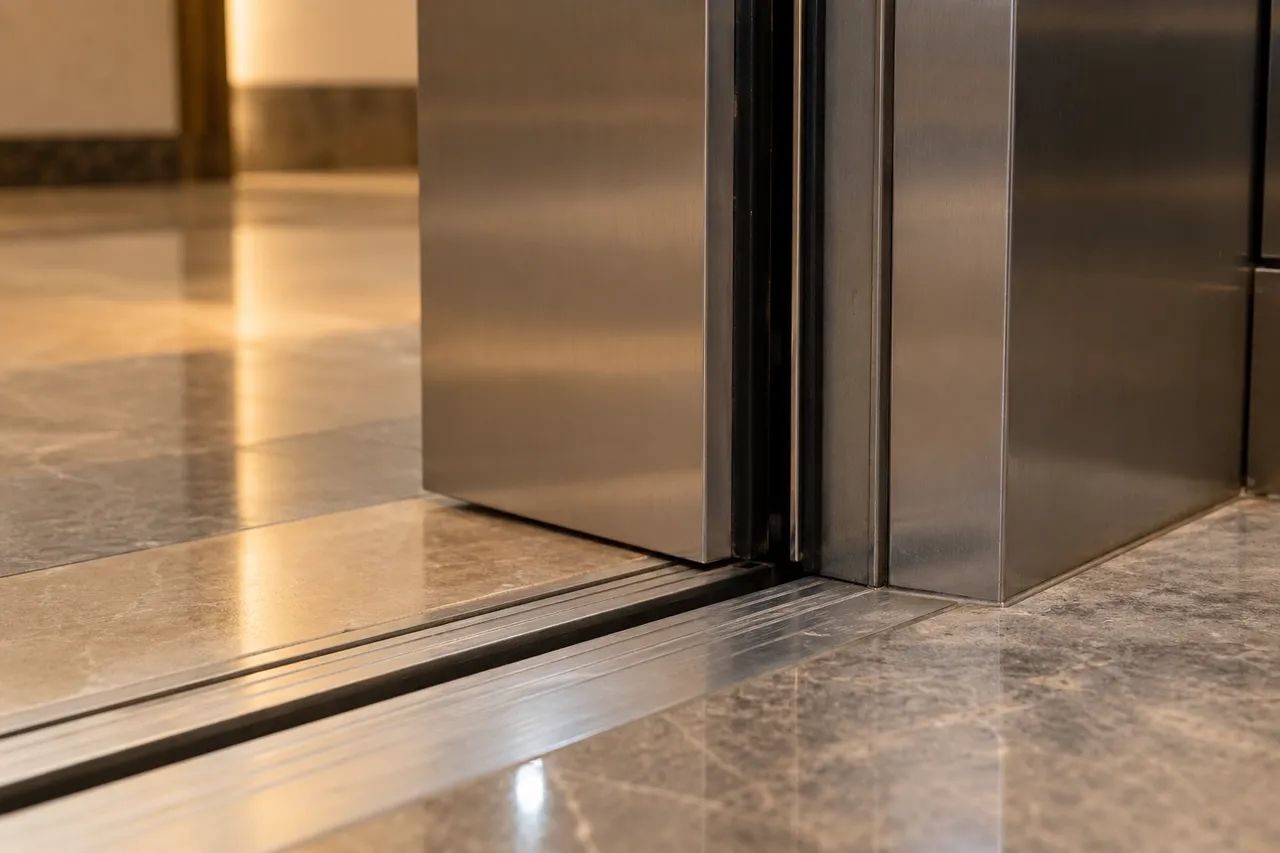
Landing door dislodgement prevention means a device that has passed a safety evaluation under Article 14(2) of the regulations, or a door assembly with a parts safety certification. Under Article 3 of the addenda, an elevator already in use after inspections under earlier standards may be judged against the standards in force when it took its completion, periodic, ad hoc or detailed safety inspection.
Illustrative image
Detailed inspection cycle and when the rule applies
Under Article 32(1)3 of the Elevator Safety Management Act, a managing entity must have a detailed safety inspection once 15 years have passed since the installation inspection, and then every three years. With the first at 15 years and the second at 18, the third falls at 21 years and the fourth at 24. The periodic inspection cycle under Article 54 of the Enforcement Rule is one year, and six months for an elevator more than 25 years past its installation inspection.
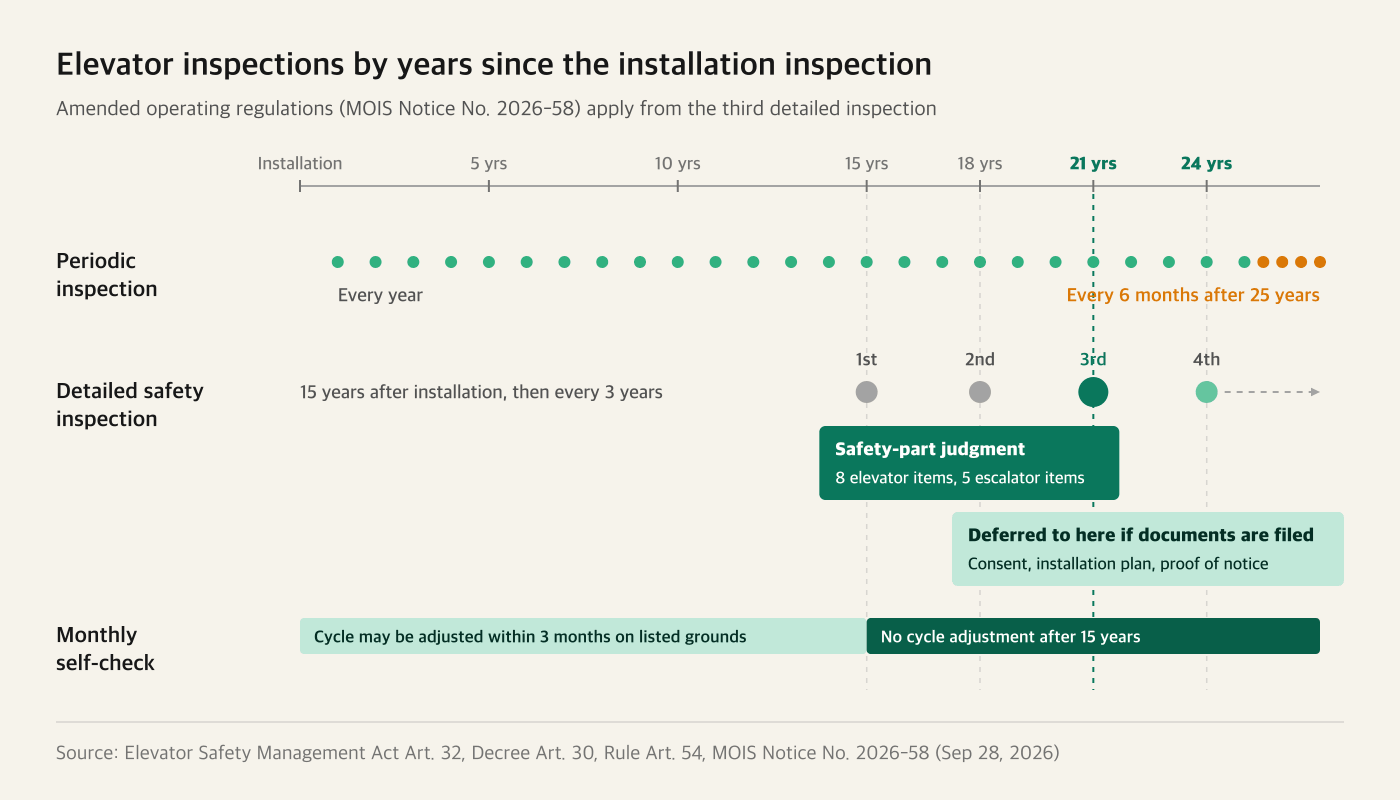
Figure 1. Elevator inspection schedule by years since the installation inspection. Source: Elevator Safety Management Act Article 32, Enforcement Decree Article 30, Enforcement Rule Article 54, MOIS Notice No. 2026-58 (September 28, 2026).
The periodic cycle has exceptions. It is six months for an elevator within two years of a serious accident or serious failure caused by an elevator defect, and two years for freight, vehicle and dumbwaiter elevators and for elevators in detached houses. The inspection window is 30 days either side of the due date. Under Article 32(2) of the Act, an elevator that has not been inspected or has failed a safety inspection may not be operated.
Deferral and compliance periods
Article 11-3(1) provides that if the managing entity submits all three documents to the Korea Elevator Safety Agency, the safety-part judgment can apply at the fourth detailed inspection, taken 24 years after the installation inspection.
| Document | Requirement |
|---|---|
| Written consent (electronic allowed) | Consent to upgrade the listed parts or devices, from at least two-thirds of residents in apartment complexes, of unit owners in multi-unit buildings, or of elevator owners in other buildings |
| Installation plan | Approved by a self-governing body such as the residents' council (apartments and multi-unit buildings) or by the owner (other buildings) |
| Proof of posted notice | A notice inside and outside the elevator stating that it may be taken out of service if the parts or devices fail the standard |
Article 11-3(2) sets the compliance periods when the detailed inspection after a deferral ends in a conditional pass. Two months are granted once a contract to install the parts or devices is signed, and two more months if installation work has started but is not finished in that time. Outside this rule, Article 13(3) limits the compliance period after a conditional pass to two months from the end of the inspection, with one extension allowed where procedures under other laws make compliance difficult.
Article 11-3(3) sets an exemption. Where installing a part or device would require a major repair under Article 2(1)9 of the Building Act and the Minister recognizes that installation is impractical, that part or device may be exempted. The managing entity must then submit a self-improvement plan to the Agency covering measures such as additional self-checks and recording and managing the safety manager's daily checks.
Self-checks and remote management
Under Article 31 of the Act, the managing entity must carry out a self-check at least once a month and enter the result in the national elevator safety information network. Article 29 of the Enforcement Decree sets the entry deadline at 10 days after the check and requires the person doing the check to report results to the managing entity as good, watch or urgent repair. A defect found in a self-check must be repaired at once and the elevator kept out of service until the repair is done, and the self-check can be delegated to a registered maintenance contractor.
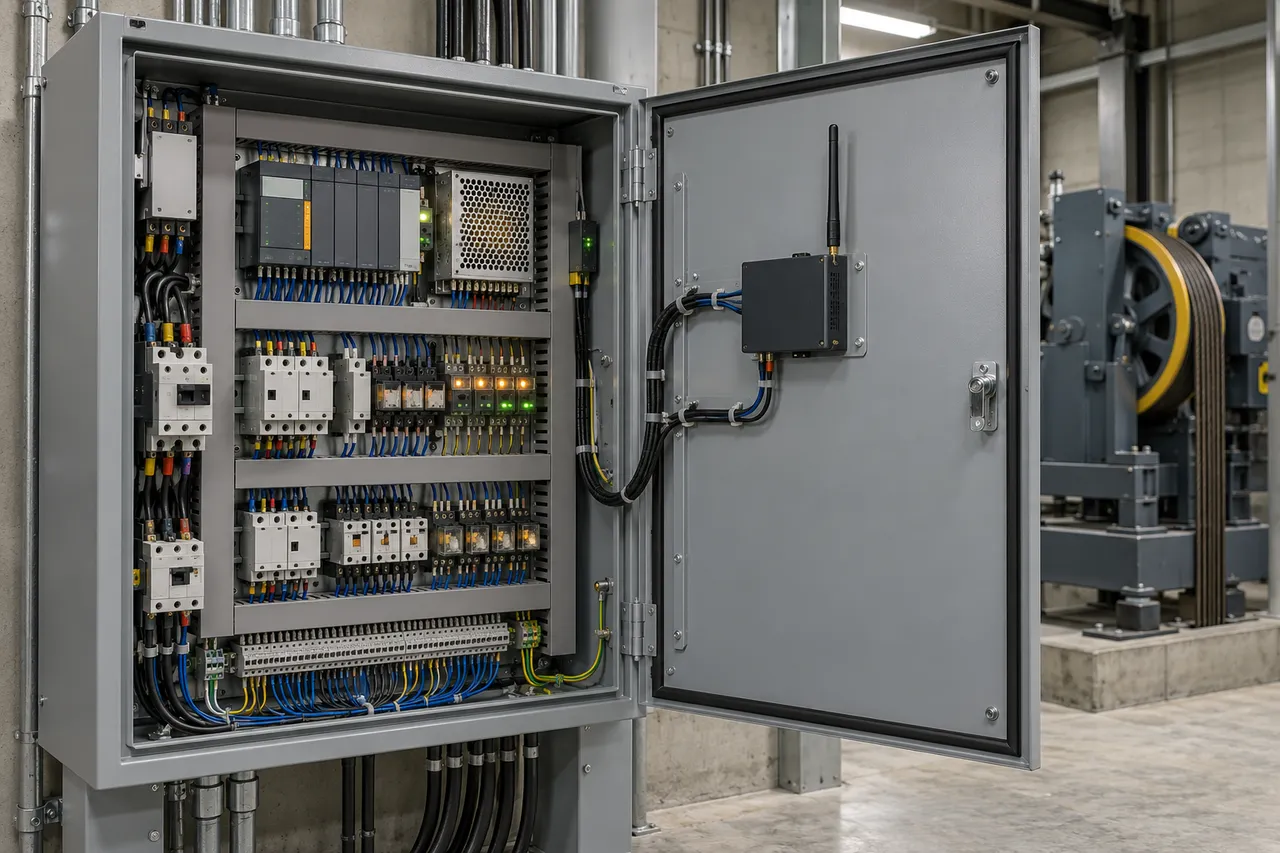
Article 30 of the Decree lists the grounds for adjusting the self-check cycle within three months; the first is managing an elevator with a remote management function such as remote inspection and real-time failure monitoring. Article 13-2 of the MOIS operating regulations on elevator operation and management defines that function as one that includes all of remote inspection such as self-diagnosis, real-time failure monitoring, operating status monitoring, remote control such as operation control, and security measures against outside hacking. A maintenance contractor that wants to adjust the cycle on this basis must give the managing entity documents proving that its remote management function meets paragraph 1 of that article and obtain its written confirmation.
Illustrative image
The adjustment has exclusions. An elevator more than 15 years past its installation inspection, one with a serious accident in the past three years, or one with three or more serious failures in the past year cannot have its self-check cycle adjusted, even with a remote management function. Elevators covered by the amended judgment, at 21 years or more, fall under this exclusion, so a remote management function cannot be used to adjust their self-check cycle. How to tie condition data to maintenance decisions is covered in the Industry Operations Note Condition-Based Maintenance: What to Decide First.
Field checklist
- Confirm the installation inspection pass date of each elevator and record when its third (21 years) and fourth (24 years) detailed inspections fall due.
- Check, elevator by elevator, whether the eight listed elevator items and five escalator items are installed.
- Identify home elevators, which are excluded, and elevators that may use earlier inspection standards.
- If a deferral is needed, confirm who must consent for the building type and the two-thirds threshold, and decide who approves the installation plan.
- Post the notice of possible suspension inside and outside the elevator and keep proof that it was posted.
- Track the dates of the parts installation contract and the start of work alongside the detailed inspection schedule, in case of a conditional pass.
- For elevators that would need a major repair, consider whether an exemption may be recognized and set out additional self-checks and daily check records in the self-improvement plan.
- Confirm that self-check results are entered in the national network within 10 days.
- For elevators whose self-check cycle was adjusted on the basis of remote management, check whether they are now more than 15 years past installation, or have had a serious accident within three years or three or more serious failures within one year.
- For new or replacement elevators, confirm the construction start certificate date or installation contract date to know in advance which installation standard applies.
Summary
MOIS Notice No. 2026-58 sets in its body how safety parts are judged when an elevator takes its third detailed safety inspection 21 years after its installation inspection, and sets a procedure to defer the rule to the fourth detailed inspection on condition of consent forms, an installation plan and a posted notice. Managing entities should confirm each elevator's installation inspection pass date and next detailed inspection, and plan the consent process and parts installation contracts together. The notice and its annexes are available from the National Law Information Center (law.go.kr).
Statutory inspection of workplace equipment and keeping the equipment list are covered in the Industry Operations Note 2026 Safety Inspection Expansion: Equipment First.
Official sources
- MOIS, notice of partial amendment to the operating regulations on elevator installation and safety inspections (MOIS Notice No. 2026-58, September 28, 2026)
- National Law Information Center, operating regulations on elevator installation and safety inspections (MOIS Notice No. 2026-58)
- National Law Information Center, operating regulations on elevator operation and management (MOIS Notice No. 2026-1)
- National Law Information Center, Elevator Safety Management Act
- National Law Information Center, Enforcement Decree of the Elevator Safety Management Act
- National Law Information Center, Enforcement Rule of the Elevator Safety Management Act