

Confined Space Gas Testing in Korea: Limits, Timing, Sampling Points and Records
Industry Operations Note special edition: Confined Space Gas Testing
Before work in a confined space, Korean rules require employers to measure oxygen and hazardous gas concentrations and confirm the air is acceptable: oxygen at 18% or more and below 23.5%, carbon dioxide below 1.5%, carbon monoxide below 30 ppm, and hydrogen sulfide below 10 ppm. An amendment to the Occupational Safety and Health Standards Rules on December 1, 2025 made it explicit that testers must be issued measuring equipment and added a new duty to record test and evaluation results and keep them for three years.
This article was written against the Occupational Safety and Health Standards Rules, Ministry of Employment and Labor (MOEL) press releases (December 1, 2025; April 29, August 2 and August 6, 2026) and notice (July 14, 2026), Korea Occupational Safety and Health Agency (KOSHA) press releases (August 6 and August 10, 2026), and the KOSHA technical support standard KOSHA GUIDE E-G-18-2026 (published January 30, 2026), as published as of August 29, 2026.
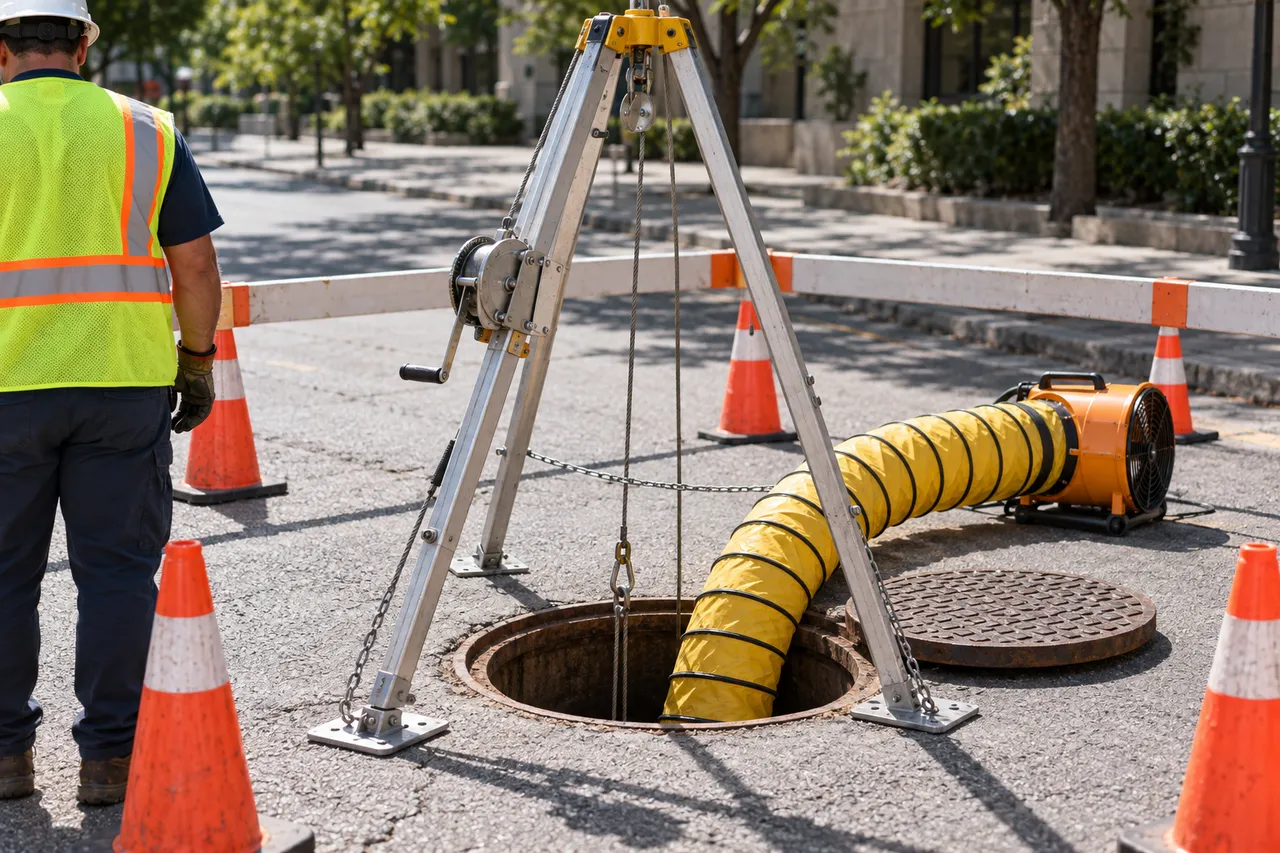
An illustrative image of ventilation being set up before manhole work. No real person can be identified, and it does not show any specific workplace or accident site.
Summer asphyxiation risk in confined spaces
MOEL says asphyxiation accidents in confined spaces such as manholes, wastewater treatment facilities and livestock barns rise sharply every year from May and recur throughout the summer (MOEL press release, April 29, 2026). The government's three core rules for confined spaces are gas testing, ventilation, and protective equipment such as supplied-air respirators or self-contained breathing apparatus.
In an emergency heat directive on August 2, MOEL explained that as temperatures rise, microbial growth and decay inside wastewater facilities, sewer lines, septic tanks and storage vessels can drive carbon dioxide and hydrogen sulfide levels up sharply. It advised local governments and others nationwide to stop confined-space work with asphyxiation risk other than emergency work (MOEL press release, August 2, 2026).
On August 10, KOSHA warned of acute poisoning risk at workplaces handling dichloromethane. The solvent has a low boiling point and evaporates easily in hot conditions, and when inhaled in large amounts it produces carbon monoxide in the body, which interferes with oxygen transport in the blood and can cause asphyxiation. In 2025 one worker died of acute poisoning while cleaning debris off a product taken out of a dichloromethane wash tank, and in 2024 one worker died and two were injured during waterproofing in an underground machine room. KOSHA called for running local exhaust ventilation, using supply and exhaust fans in poorly ventilated spaces, and wearing respiratory protection such as supplied-air respirators (KOSHA press release, August 10, 2026).
Heat-work rest rules are covered in Korean heat-work rest requirements.
Manhole accident patterns and pre-work checks
On August 6, KOSHA released a manhole work safety guide and said it would distribute it to 224 local governments and public institutions. The guide notes that five workers died in water and sewer manholes in Incheon and Seoul last July, and that six were injured in sewer manholes in Jeonbuk and Incheon this year. It describes three accident patterns: a worker climbing down a ladder loses consciousness from oxygen deficiency or hazardous gas and falls; a worker who has fallen keeps inhaling gas; and a coworker who goes in to help becomes a second casualty. The guide covers how to test, ventilate and wear supplied-air respirators, along with the use of a rescue tripod (KOSHA press release, August 6, 2026).
The same day, MOEL and the City of Incheon announced a joint declaration to end manhole asphyxiation accidents. In Incheon, asphyxiation in manholes and other confined spaces killed two people last year and injured three this year. Incheon Environmental Corporation is piloting a pre-work safety check system at its sites: work is approved only after oxygen and hazardous gas levels and ventilation have been verified by video or on-site inspection (MOEL press release, August 6, 2026).
According to MOEL's April 29 release, pre-work safety measures for manhole work ordered by local governments have been checked before work since July 31, 2025. Seven people died of asphyxiation in manholes in 2025 before July, and no further manhole asphyxiation deaths had occurred between the start of these checks and the date of the release. MOEL said it would keep the check system running throughout the heat season from May 15 to September 30 and run focused inspections of storage vessels, reactors and process piping in manufacturing (MOEL press release, April 29, 2026).
Acceptable air limits
Article 618 of the Occupational Safety and Health Standards Rules defines oxygen deficiency as an oxygen concentration in air below 18%. Hazardous gases are gases such as carbon dioxide, carbon monoxide and hydrogen sulfide. A confined space is a place listed in Annex 18 of the rules where oxygen deficiency or hazardous gas creates a risk of asphyxiation, fire or explosion.
The same article defines acceptable air as oxygen at 18% or more and below 23.5%, carbon dioxide below 1.5%, carbon monoxide below 30 ppm, and hydrogen sulfide below 10 ppm. Oxygen has both a lower and an upper bound, so a reading above 18% still fails if it reaches 23.5%. The other three gases have only an upper limit.
Pre-entry testing duty and the tester
Under Article 619-2, the employer must measure oxygen and hazardous gas concentrations before confined-space work begins and evaluate whether acceptable air is maintained. Restarting after a temporary stop counts as starting work. Testing is done by a designated person with knowledge of and practical experience in measurement and evaluation. Remote measurement using radio equipment and radio communication under the Radio Waves Act is accepted as a testing method.
Since an amendment on June 28, 2024, the employer must confirm and train testers on the hazards of confined spaces, how to check measuring equipment for faults and operate it, measurement methods, and the acceptable air limits and evaluation method (KOSHA amendment guide). If the air is found not to be acceptable, the employer must ventilate or provide and require supplied-air respirators or self-contained breathing apparatus, among other measures.
Testing is one part of a confined-space work program. Article 619 requires a program covering where the confined spaces are, control of hazards, pre-work check procedures, and education and training. The pre-work checks include gas measurement results and follow-up actions, and the checked items must be posted at the entrance until the work ends. Article 620 requires ventilation before and during work to keep the air acceptable, and Article 621 requires a headcount at entry and exit. Under Article 640, emergency rescue drills must be held at least once every six months and recorded.
December 2025 amendments
MOEL promulgated an amendment to the Occupational Safety and Health Standards Rules on December 1, 2025, effective the same day. The amendment added to Article 619-2(1) an explicit duty to issue measuring equipment to testers. A new Article 619-2(4) requires measurement and evaluation results, including the name of the person who measured and evaluated, the date, time and place, and the results, to be recorded and kept for three years, and recording with fixed or mobile video devices is included (MOEL press release, December 1, 2025).
The same amendment requires the attendant to report to the local fire station without delay when something goes wrong with a worker, and requires the employer to confirm that workers understand the safe work methods explained before work and to train them (Article 641). With recording now mandatory, checking the display on a gas meter is not enough; the record has to show who measured what, when and where.
When and where to measure
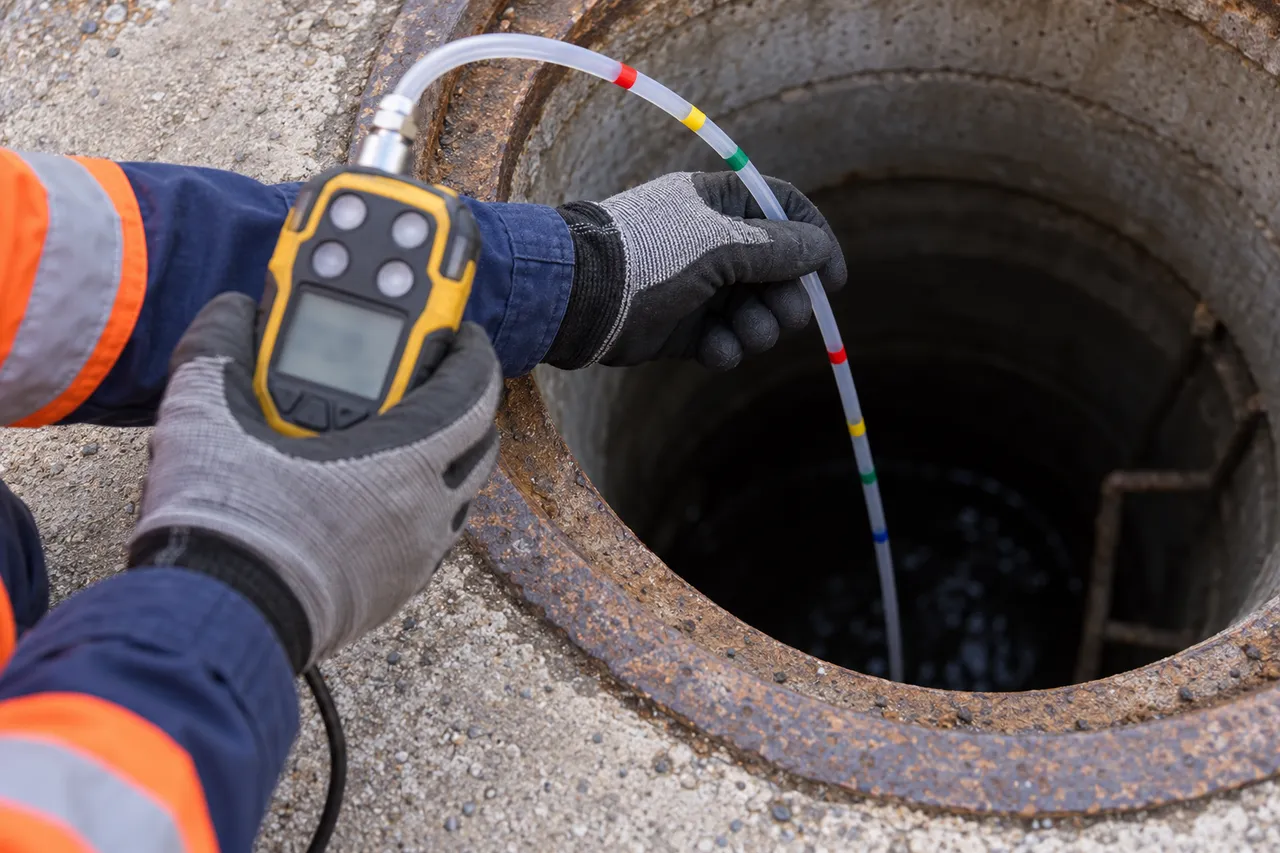
An illustrative image of sampling manhole air through a hose. The readings on the detector are not real values, and it does not represent any specific product.
The KOSHA technical support standard KOSHA GUIDE E-G-18-2026 (published January 30, 2026, revising H-80-2021) sets out testing times in more detail than the rules. Test before work begins each day, before work starts after the first shift change of the day where work runs in shifts, and before work resumes after everyone has left the space. Also test as needed when a worker's health or the ventilation equipment shows a problem, and whenever hazardous gas may be generated.
Air in a confined space does not circulate well, so concentrations can differ widely by position. The guideline calls for measuring at three or more points both vertically and horizontally, centered on workers' breathing zones. The guideline states that the judgment "must apply the highest of the concentrations measured at the various points in one confined space." For hazardous gases, where a higher concentration is more dangerous, the highest reading is the worst case. For oxygen, Article 618 defines a concentration below 18% as oxygen deficiency, so any single point below 18% is oxygen deficient. Oxygen therefore also has to be judged on its lowest reading, and checked against the 23.5% upper limit.
Measurement uses a portable gas detector. For places such as deep tanks, where the inside must be tested before anyone enters, use a rubber or PVC sampling tube marked with small graduations every 1 m and large graduations every 5 m, and sample evenly across the area and depth. With a long sampling tube, purge at least the tube's internal volume before taking a reading. To measure the concentration at the work point accurately, the guideline recommends pump-type (aspirated) detectors, and diffusion-type detectors must be used with accessories that can sample the air inside the space.
Instrument care and continuous monitoring during work
The guideline calls for choosing a detector suited to the target gas and maintaining it to keep accuracy and precision. Before testing, calibrate the detector against reference concentrations and alarm set points, and use explosion-proof equipment. KOSHA's amendment guide notes that most measuring equipment has an alarm that sounds when the acceptable air limits are exceeded, or at a lower warning level.
Testing does not end before work starts. During work, workers carry portable detectors and measure as needed. Where hazardous gas can keep forming during the job, such as work using combustion engines like pumps, sludge removal, or concrete curing, measure continuously and leave immediately when the alarm sounds.
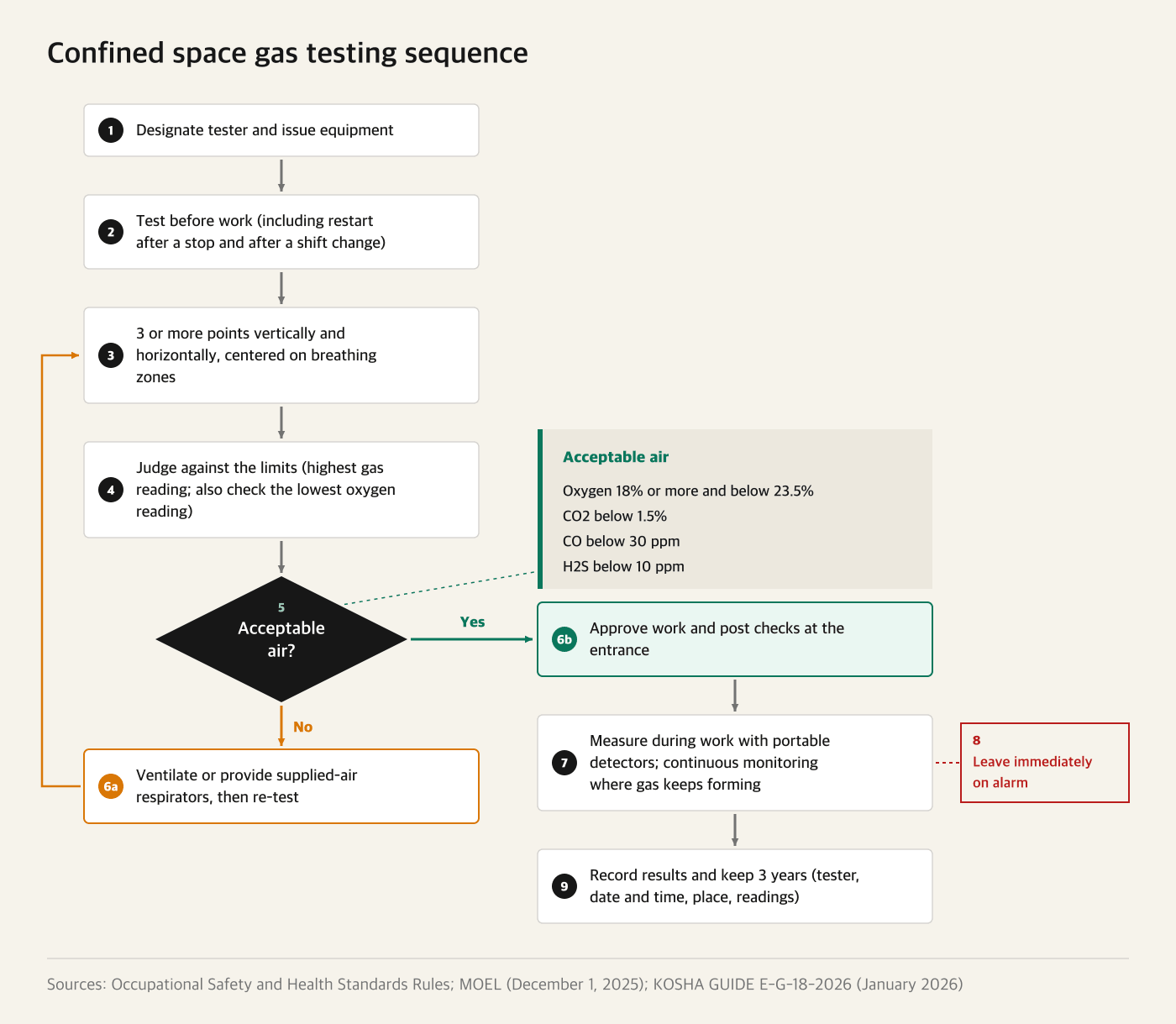
Figure 1. Gas testing sequence before and during confined-space work. Sources: Occupational Safety and Health Standards Rules; MOEL (December 1, 2025); KOSHA GUIDE E-G-18-2026 (January 2026).
Flammable gas in underground workplaces
Flammable gas limits apply in a different context from the acceptable air limits. Article 296 requires employers to appoint a gas tester in underground workplaces and similar places where flammable gas may be generated. Testing is required before work starts each day, when a leak is suspected, when there are spots where gas may accumulate, and every four hours during long work. If the concentration reaches 25% or more of the lower flammable limit, workers must be evacuated immediately, machinery that could become an ignition source must be stopped, and the area must be ventilated.
MOEL gave advance notice of an amendment to this article on July 14. The draft specifies the underground workplaces subject to testing as those with facilities that store or handle flammable substances, or where flammable vapor or gas may arise from the decay and decomposition of sewage, wastewater or night soil. The comment period ended on August 24, and the final text will be set when the amendment is promulgated (MOEL notice). The related subordinate-legislation drafts are covered in Korea's draft OSH decree amendments.
Field checklist
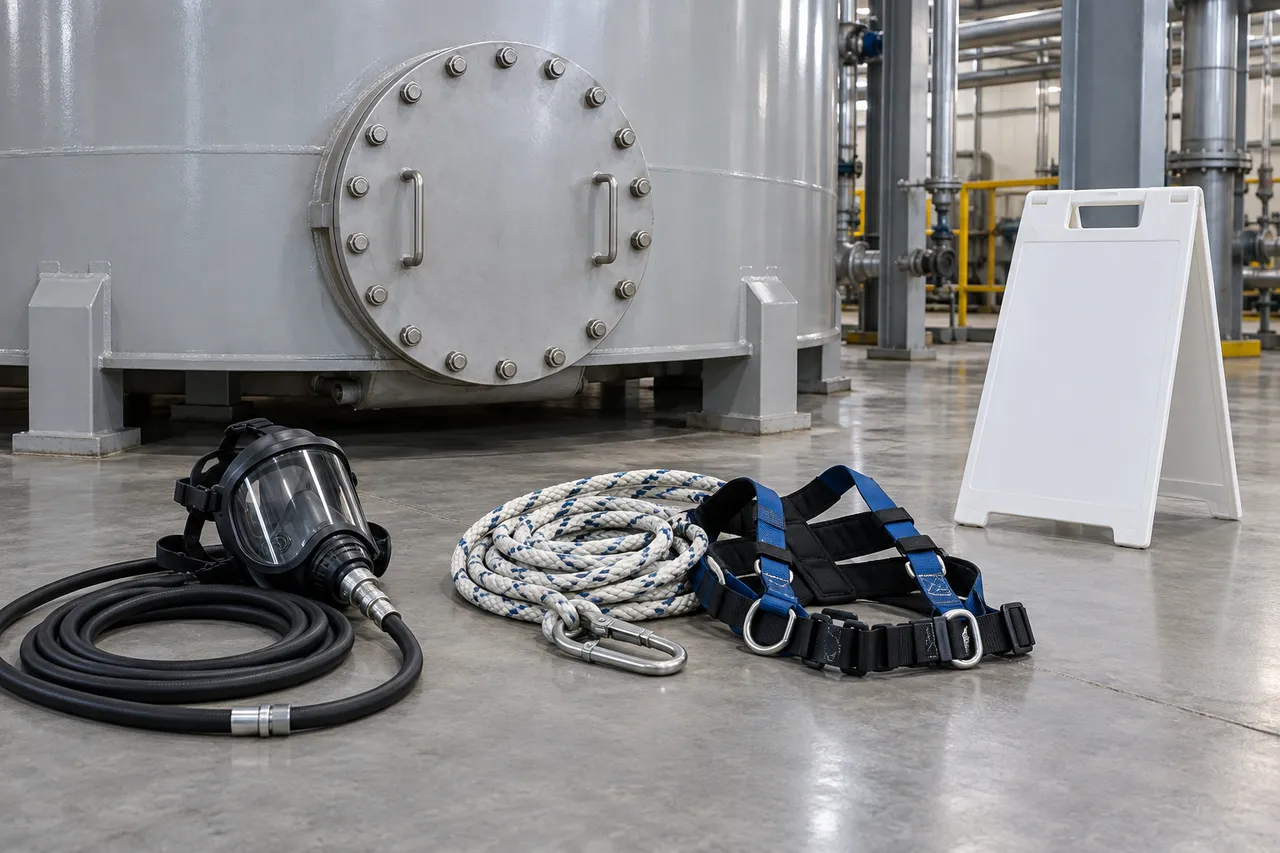
An illustrative image of preparations in front of a storage tank manway. No people appear, and it does not show any specific workplace.
- Compare your list of confined spaces with Annex 18 of the rules, and make sure work inside storage vessels, reactors and process piping is on it.
- Confirm that testers are designated and issued equipment, and that they know how to check the equipment for faults, how to operate it, and the acceptable air limits.
- Write into the work procedure that testing happens before work starts, before restarting after a temporary stop, and after a shift change.
- Measure at three or more points both vertically and horizontally, centered on breathing zones. Judge hazardous gases by the highest value, and check that the lowest oxygen reading is at least 18%.
- When using a long sampling tube, purge at least its internal volume before taking a reading.
- Calibrate detectors against reference concentrations and alarm set points before testing, and confirm the equipment is explosion-proof.
- Designate work using combustion engines, sludge removal and concrete curing for continuous monitoring during work.
- Record the tester's name, date and time, place and results, keep them for three years, and keep the ventilation and re-test results when the air was not acceptable.
- For underground workplaces where flammable gas may arise, manage the four-hour testing interval and the evacuation threshold of 25% of the lower flammable limit separately.
- Confirm the procedure for the attendant to report to the fire station and the records of emergency rescue drills held at least once every six months.
Summary
Confined-space gas testing is a procedure set by the rules and technical guidance, covering not only the acceptable air limits but also when and where to test, how to judge the results, and how long to keep records. With MOEL keeping pre-work manhole checks in place through September 30 and running focused inspections of manufacturing storage vessels and reactors, now is the time to review your testing procedure and record forms. The Article 296 amendment is still at the advance-notice stage, so check whether it is promulgated and what the final text says. The full text of the rules is available from the National Law Information Center.
Equipment isolation and lockout are covered in Operations Note 4, LOTO for maintenance and cleaning.
Official sources
- National Law Information Center, Occupational Safety and Health Standards Rules
- MOEL, press release on the amended Occupational Safety and Health Standards Rules (December 1, 2025)
- MOEL, press release on preventing confined-space asphyxiation (April 29, 2026)
- MOEL, press release on the emergency heat directive (August 2, 2026)
- KOSHA, press release on the manhole work safety guide (August 6, 2026)
- MOEL, press release on the Incheon declaration on manhole asphyxiation (August 6, 2026)
- KOSHA, press release on dichloromethane acute poisoning (August 10, 2026)
- MOEL, advance notice of the draft amendment to the Occupational Safety and Health Standards Rules (July 14, 2026)
- KOSHA, guide to the amended confined space rules
- KOSHA, KOSHA GUIDE E-G-18-2026, technical support standard on establishing and running confined space work programs (January 30, 2026)