UPS Battery Rooms After the NIRS Data Center Fire
Updated
Korea's interior ministry said on October 2, 2026 that 56 of 1,459 public IT facilities had not separated lithium batteries into a UPS battery room. The Ministry of the Interior and Safety (MOIS) surveyed all public information-system facilities and gave the results at a briefing marking one year since the National Information Resources Service (NIRS) fire. The separation rules, set in the MOIS notice on integrated standards for information resources of administrative and public institutions, were revised in February 2026; their facility stability standards include separate UPS and battery rooms, battery service-life management and 24-hour monitoring of major equipment.
Current as of October 11, 2026.
Illustrative image
The NIRS fire and the follow-up measures
According to the MOIS disaster headquarters briefing, the fire broke out at about 8:15 p.m. on September 26, 2025, while workers were moving the NIRS uninterruptible power supply (UPS) batteries to the basement. It started in one battery whose power had been cut off and was put out at about 6:30 a.m. the next day. 647 work systems at the Daejeon headquarters were shut down. MOIS explained that the fire stopped the precision air conditioning from working properly, so it shut the systems down pre-emptively to keep the servers from overheating.
At the briefing a year later, on October 2, 2026, MOIS set out its follow-up. In February it revised the integrated standards to specify that lithium batteries must be separated from IT equipment and UPS units, and it tightened management rules such as battery condition monitoring and compliance with service life. It then surveyed 1,459 public information-system facilities, found 56 that did not separate lithium batteries as required, and recommended immediate improvement in May. MOIS plans to track each institution's action plan until completion and to support a move to private cloud for facilities whose space or building structure rules out direct improvement.
In April MOIS also issued a stability notice for information systems of administrative and public institutions, which grades systems by their impact on daily life rather than by user numbers. About 15,000 public systems were regraded by August. A1 systems are to run a secondary system at another center, with the aim of restoring service within one hour of a disaster. The NIRS Daejeon center is scheduled to close in 2030.
How the facility stability standards apply
The revised notice is MOIS Notice No. 2026-11, issued and effective on February 11, 2026. Article 15 sets the inspection standards for the stability of information-system facilities run by central government bodies and their agencies, local governments and public institutions in Annex 3. Heads of these bodies must work to meet the standards, and a newly built facility must meet them.
Annex 3 sets the required level by the grade of the systems a facility runs. Facilities running grade 1 or 2 systems must meet the high level, grade 3 the medium level, and grade 4 the low level. Each item is marked mandatory or recommended for each level.
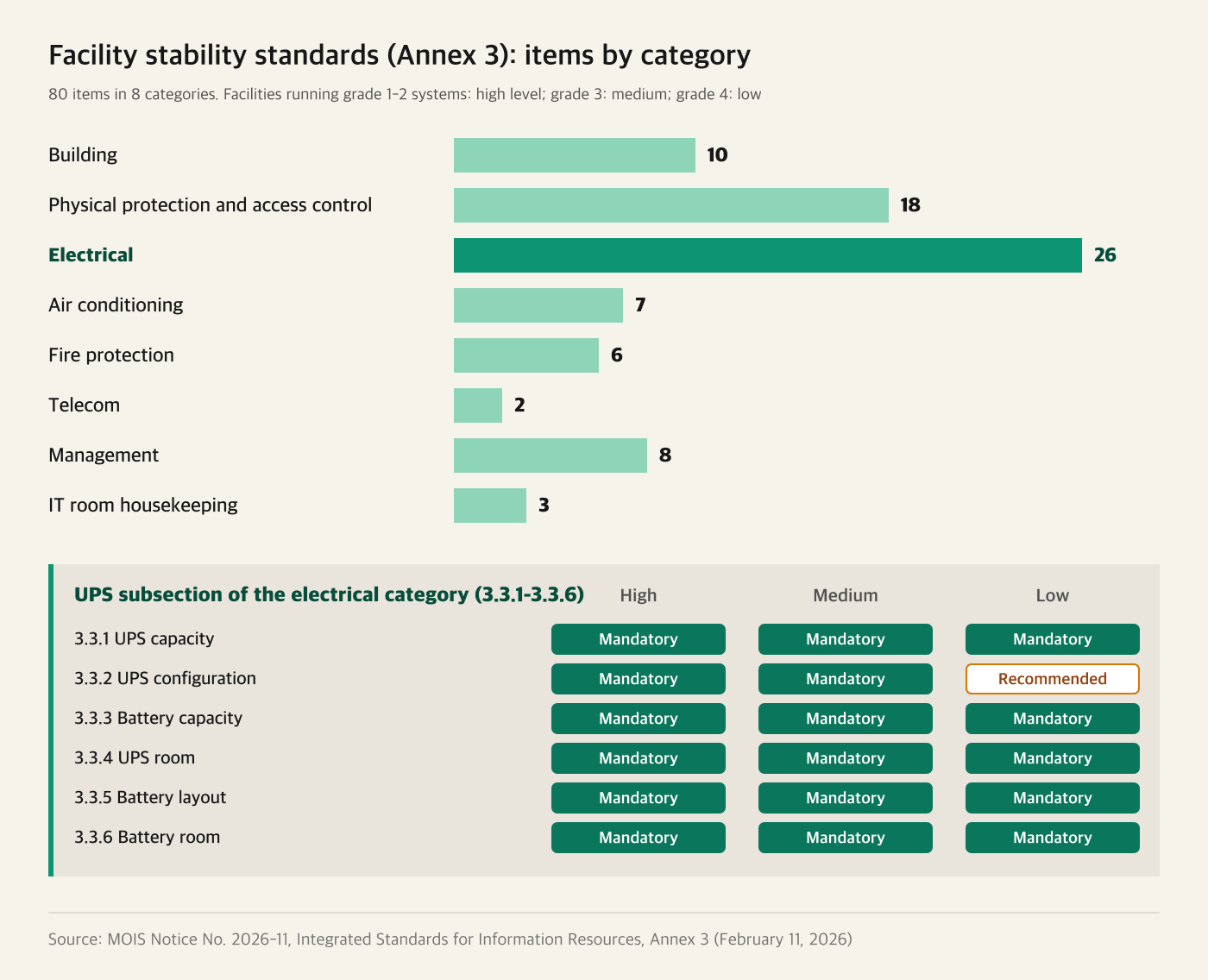
Figure 1. Items by category in the information-system facility stability standards (Annex 3). Source: MOIS Notice No. 2026-11, Integrated Standards for Information Resources of Administrative and Public Institutions (February 11, 2026).
Annex 3 has 80 items in eight categories. Electrical is the largest category with 26 items, and the UPS and battery rules sit in it. Under Article 16, heads of institutions must carry out a status survey and self-inspection against Annex 3 every year and register the results in the Information Resource Management system (IRM). The Minister of the Interior and Safety can review the results, order on-site inspections and recommend improvements where the standards are not met. An institution that receives a recommendation must submit an action plan within one month and report the result without delay once the work is done.
UPS battery room and battery rules
The uninterruptible power supply subsection of Annex 3 has six items. UPS configuration is recommended at the low level; the other five items are mandatory at all three levels.
| Item | Requirement | High | Medium | Low |
|---|---|---|---|---|
| 3.3.1 UPS capacity | At least 130% of the three-month average load | Mandatory | Mandatory | Mandatory |
| 3.3.2 UPS configuration | Uninterrupted supply despite a partial failure | Mandatory | Mandatory | Recommended |
| 3.3.3 Battery capacity | At least 15 minutes at full (100%) load until generator power arrives | Mandatory | Mandatory | Mandatory |
| 3.3.4 UPS room | Separate space with fire-rated walls, apart from IT equipment; separate spaces per load for a 2N UPS | Mandatory | Mandatory | Mandatory |
| 3.3.5 Battery layout | Spacing against fire and explosion by battery type, service-life management, control and monitoring | Mandatory | Mandatory | Mandatory |
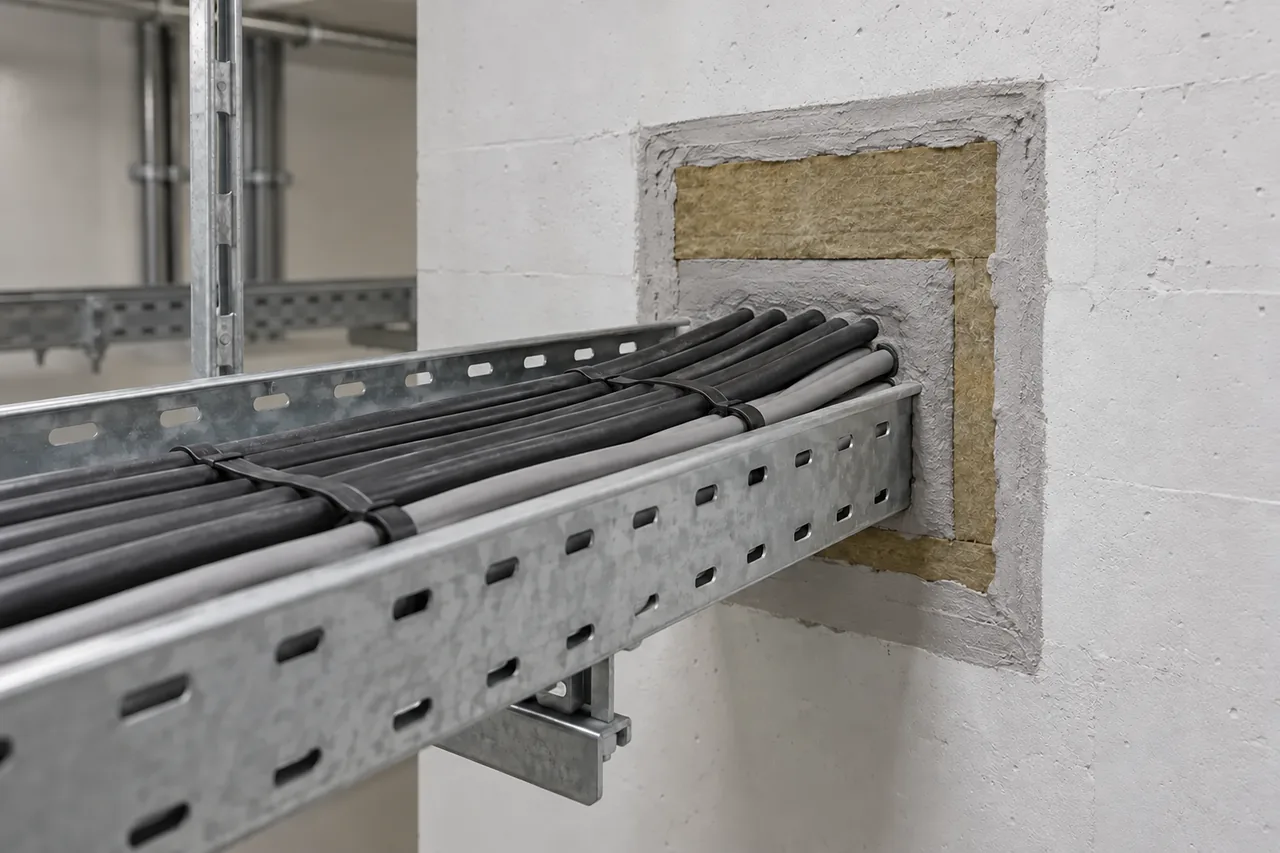
| 3.3.6 Battery room | Separate space with fire-rated walls and fire doors, sealed cable penetrations, no power lines other than UPS connections | Mandatory | Mandatory | Mandatory |
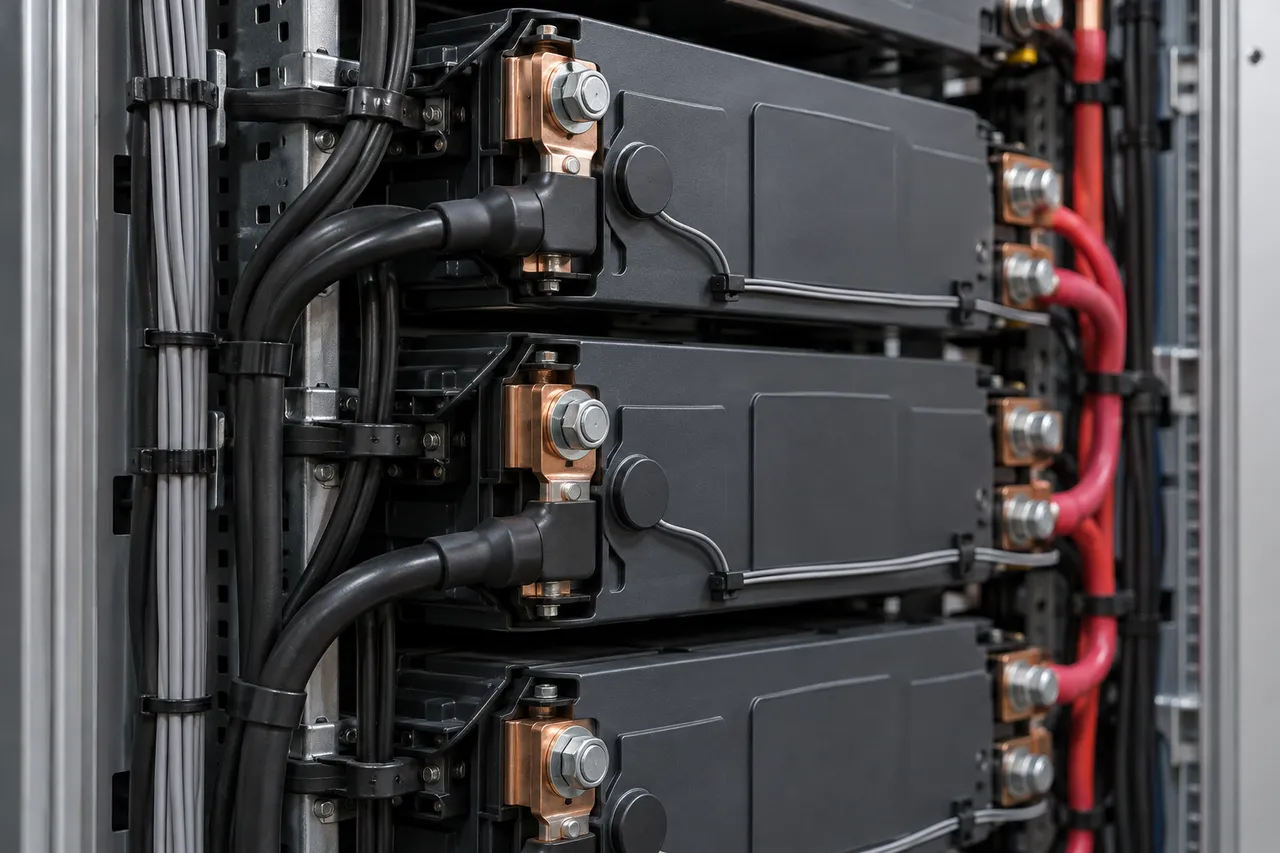
The battery-room item requires batteries to be installed apart from IT equipment and UPS units. Sealing cable penetrations and keeping power lines other than UPS connections out of the battery room are part of the required safety measures. The battery-layout item adds service-life management, control and monitoring to spacing, and it is mandatory for every facility whatever its grade.
Illustrative image
Equipment monitoring and maintenance rules
The management category covers facility monitoring and maintenance. A central monitoring room that watches the operation of IT rooms, telecom rooms and electrical rooms and any incidents there is mandatory at all levels. A system and management arrangements that monitor and control the condition of major equipment such as electrical systems, precision air conditioners and UPS units in real time, 24 hours a day, is mandatory at the high level and recommended at the medium and low levels.
The maintenance item requires major equipment, including electrical, air-conditioning and fire systems, to be kept from deteriorating, with parts replacements and repairs recorded; it is mandatory at all levels. Control and monitoring equipment must run on UPS power and be able to take generator power during an outage. The fire protection category requires heat or smoke detectors, with cross-zoned circuits of two or more detector types in major rooms such as electrical, IT and telecom rooms.
The standards do not specify the type of battery monitoring equipment or a measurement interval. Which signals to use for battery condition monitoring, and who receives an alarm and what they do next, are for each institution to set in its operating manual and routine inspection checklist. What to decide before deploying monitoring is covered in the Industry Operations Notes post Industrial Monitoring: From PoC to Operations.
Comparison with the private data center guidelines
Private integrated information and communications facilities (data centers) fall under the MSIT Protection Guidelines for Integrated Information and Communications Facilities. MSIT revised the guidelines after the fire and service outage at a data center in Pangyo on October 15, 2022, and the revision took effect on June 1, 2024. The guidelines are more specific about how batteries must be monitored than the integrated standards.
| Topic | Integrated standards, Annex 3 | Data center protection guidelines |
|---|---|---|
| Scope | Information-system facilities of administrative and public institutions | Operators of integrated information and communications facilities |
| Battery room separation | Separate space with fire-rated walls and fire doors, by battery type | Separate compartment when the lithium battery capacity feeding one UPS exceeds 20 kWh; fire blankets or other spread prevention below 20 kWh |
| Power lines in the battery room | No power lines other than UPS connections | No power lines other than UPS connections, except server rooms with battery-integrated servers |
| Battery monitoring | Service-life management, control and monitoring | BMS checking cell temperature, voltage and other states, measurement interval of 10 seconds or less, plus an auxiliary system for early detection of fire signs |
| Emergency disconnection and exhaust | No specific item | Automatic or manual UPS-battery disconnection, rapid exhaust system |
| UPS capacity | At least 130% of the three-month average load, at least 15 minutes of battery | 130% of three-month average instantaneous power for at least 15 minutes |
The guidelines require adequate spacing between lithium batteries and between batteries and walls; racks with fire-resistant partitions between them, or batteries meeting UL9540A or an equivalent standard, can be exempted. CCTV for continuous monitoring must be installed inside the battery room. A facility built before the revision took effect is deemed to meet the detailed protection standards once it completes, as planned, an alternative action plan that the MSIT Minister has accepted as adequate after review by the protection measures council.
Illustrative image
Field checklist
- Identify the highest grade of system the facility runs and the stability level (high, medium or low) that follows from it.
- Check whether lithium batteries share a space with IT equipment or UPS units, and whether the battery room is enclosed by fire-rated walls and fire doors.
- Check for power lines through the battery room that are not UPS connections, and whether cable penetrations are sealed.
- Keep a register of each battery string's installation date and the manufacturer's recommended replacement date, and check for batteries past their service life.
- Write into the operating manual who watches UPS and battery condition, on which screen and at what interval.
- Decide who receives alarms, how the site is checked and who has authority to disconnect the UPS from the batteries.
- Record parts replacements and repairs for each piece of equipment and reflect them in the routine failure-prevention checklist.
- Register the yearly status survey and self-inspection in IRM, and submit an action plan within one month of any improvement recommendation.
- Before moving or replacing batteries, decide the power isolation scope and work sequence and include them in the work permit procedure.
Summary
After the NIRS fire, MOIS revised the integrated standards to make separate installation, condition monitoring and service-life compliance for lithium batteries part of the stability standards for public information-system facilities, and it recommended improvements to the 56 of 1,459 facilities that did not separate their batteries as required. Public institutions must self-inspect against Annex 3 every year, so battery-room enclosure, power-line routing, the service-life register and the monitoring and alarm arrangements are worth checking before the next inspection. The notice and its annexes are available from the National Law Information Center (law.go.kr).
Tools that continuously check ambient signals in a battery room, such as sound, temperature, humidity and VOCs, can be considered as a supplement to the BMS and fire detection systems rather than a replacement. The setup is described on the battery fire early detection solution page. Regulatory developments for lithium battery processes are covered in the Workplace Safety Field Guide special edition Draft OSH Decree Adds Lithium Primary Cells to PSM.
Official sources
- Korea Policy Briefing, briefing on the first anniversary of the NIRS fire (October 2, 2026)
- Korea Policy Briefing, disaster headquarters briefing on the NIRS administrative system fire (September 27, 2025)
- National Law Information Center, Integrated Standards for Information Resources of Administrative and Public Institutions (MOIS Notice No. 2026-11)
- National Law Information Center, Protection Guidelines for Integrated Information and Communications Facilities (MSIT Notice No. 2024-19)