

Korea's Draft OSH Decree Adds Lithium Primary Battery Plants to PSM and Tightens Fatality Disclosure
Workplace Safety Field Guide special edition: draft amendments to Korea's OSH subordinate regulations
On July 14, 2026, Korea's Ministry of Employment and Labor (MOEL) issued advance notice of draft amendments to the Enforcement Decree and Enforcement Rule of the Occupational Safety and Health Act and to the Rules on Occupational Safety and Health Standards. The draft decree would add lithium-thionyl chloride primary battery manufacturing to the industries that must submit a process safety report, and would extend public disclosure of workplace accident counts to workplaces with one or more fatalities a year.
This article was written against MOEL Notices No. 2026-362, 2026-363 and 2026-364 (advance notice of legislation, July 14, 2026) and the current statutes on the National Law Information Center, as published as of August 8, 2026. None of the three drafts is final law, and their content may change through consultation and review.
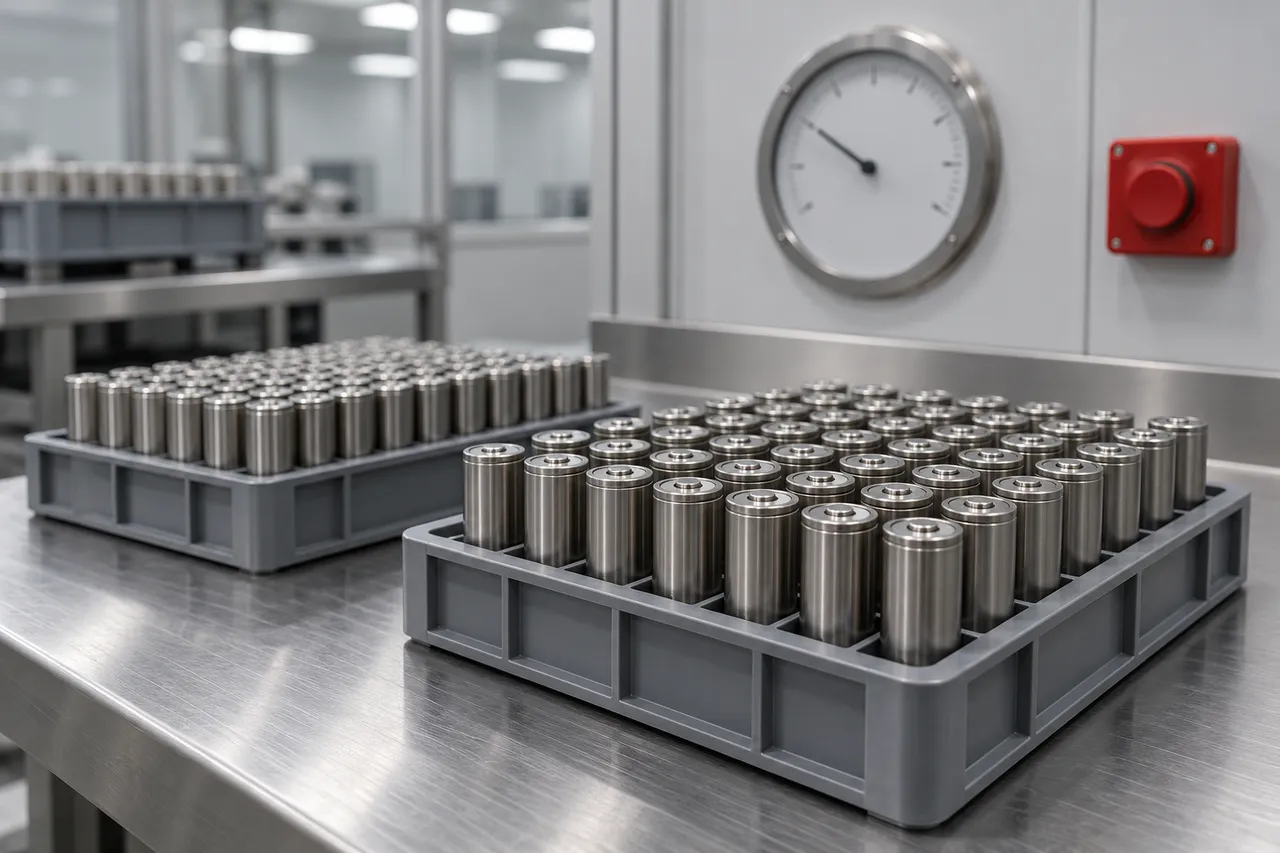
An illustrative image of battery cells arranged in a low-humidity assembly room. It does not show any specific workplace or accident site, or any real product.
The advance notice
The notice covers three sets of subordinate occupational safety and health regulations at once. The draft Enforcement Decree is MOEL Notice No. 2026-362, the draft Enforcement Rule is No. 2026-363, and the draft amendment to the Rules on Occupational Safety and Health Standards (the Standards Rules) is No. 2026-364. The notice period runs from July 14 to August 24 (MOEL notice on the draft decree).
MOEL gave three reasons for the changes: expanding disclosure to strengthen companies' responsibility for preventing workplace accidents, bringing lithium-thionyl chloride primary battery manufacturing under process safety management (PSM) to prevent the fires and explosions that keep recurring at industrial sites, and rationalizing staffing standards for safety and health training institutions.
A separate decree amendment approved by the Cabinet on July 21 (Presidential Decree No. 36540, promulgated July 28, in force August 1) is not part of this notice. That amendment dealt with safety and health disclosure, honorary occupational safety inspectors, administrative fines for risk assessment, and broader coverage of safety and health improvement plans, among other items.
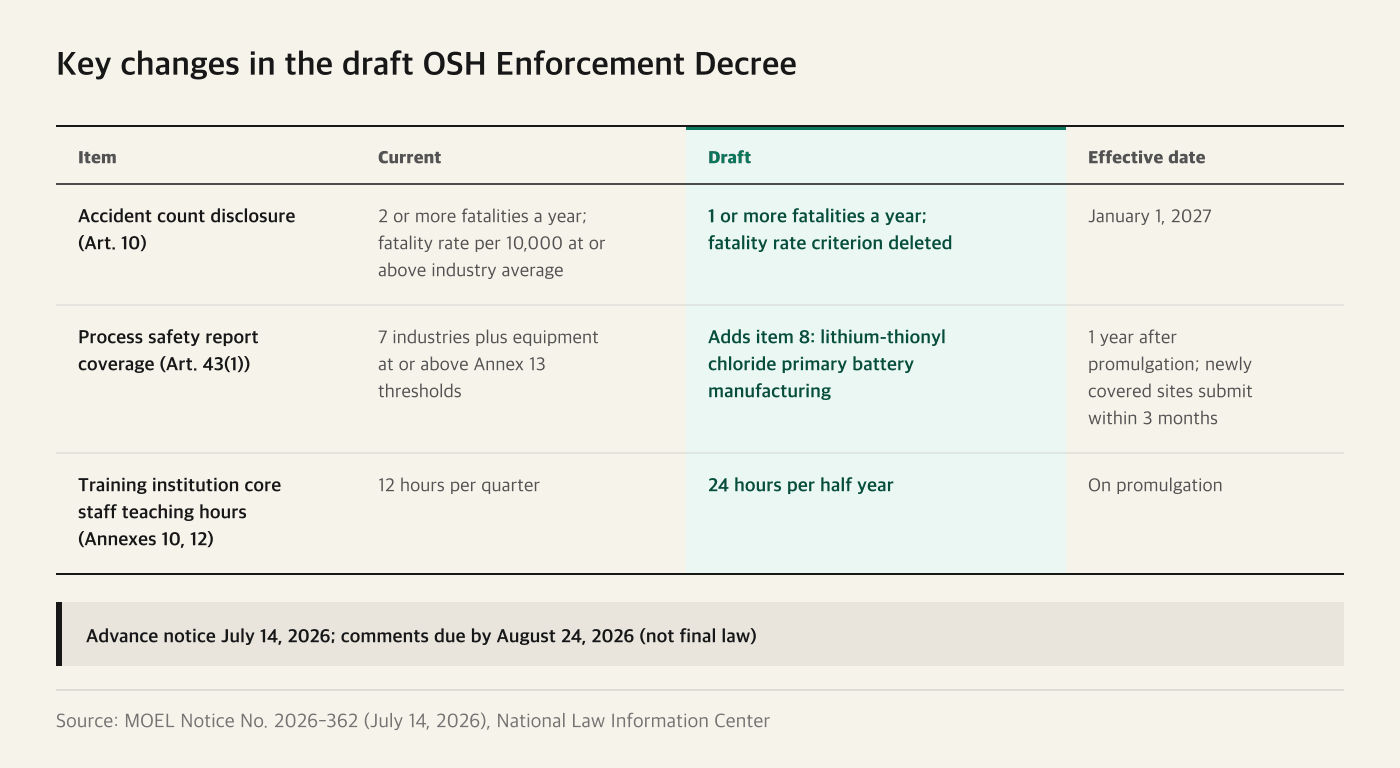
Figure 1. Key changes in the draft Enforcement Decree of the Occupational Safety and Health Act compared with the current decree. Source: MOEL Notice No. 2026-362 (July 14, 2026) and the current decree on the National Law Information Center.
A new industry on the process safety report list
Article 43(1) of the current Enforcement Decree lists seven industries that must submit a process safety report: crude oil refining, reprocessing of other refined petroleum products, manufacture of petrochemical basic chemicals or of synthetic resins and other plastics (the latter only in limited cases), nitrogenous fertilizer manufacturing, compound fertilizer manufacturing, manufacture of pesticide active ingredients, and manufacture of explosives and fireworks. Workplaces outside these industries are also covered if they have equipment that manufactures, handles or stores hazardous substances listed in Annex 13 at or above the threshold quantities.
The draft adds a new item 8: "among primary battery manufacturing, the manufacture of lithium batteries using thionyl chloride as the electrolyte."
The draft sets this change to take effect one year after promulgation. Under the transitional provision in the addenda, a workplace that was not previously required to submit a report and becomes newly covered must submit one within three months of the amended provision taking effect. Because the promulgation date has not been set, the actual submission deadline is not yet fixed either.
What a process safety report contains and what it commits you to

An illustrative image of process safety documents and piping drawings under review. No person is identifiable, and the documents do not belong to any specific workplace.
Article 44 of the Occupational Safety and Health Act requires an employer with hazardous and dangerous equipment to prepare and submit a process safety report and have it reviewed, in order to prevent major industrial accidents. The employer may not operate that equipment until it receives notice that the report is adequate. The report must go through the occupational safety and health committee, or, where there is no committee, the employer must hear the opinion of the workers' representative.
Under Article 44 of the Enforcement Decree, the report contains process safety information, a process hazard assessment, a safe operation plan, an emergency response plan, and other items specified by the Minister of Employment and Labor. A major industrial accident here means a leak, fire or explosion at covered equipment that could kill or injure workers, or that could cause human harm to nearby residents (Article 43(3) of the Enforcement Decree).
Submission is not the end of the obligation. Under Article 46 of the Act, the employer must carry out the reviewed report, have its implementation checked, and supplement the report without delay when a reason for change arises. A newly covered workplace needs a way to keep implementation records, not only the documents themselves.
Fire and explosion risk in battery manufacturing and handling
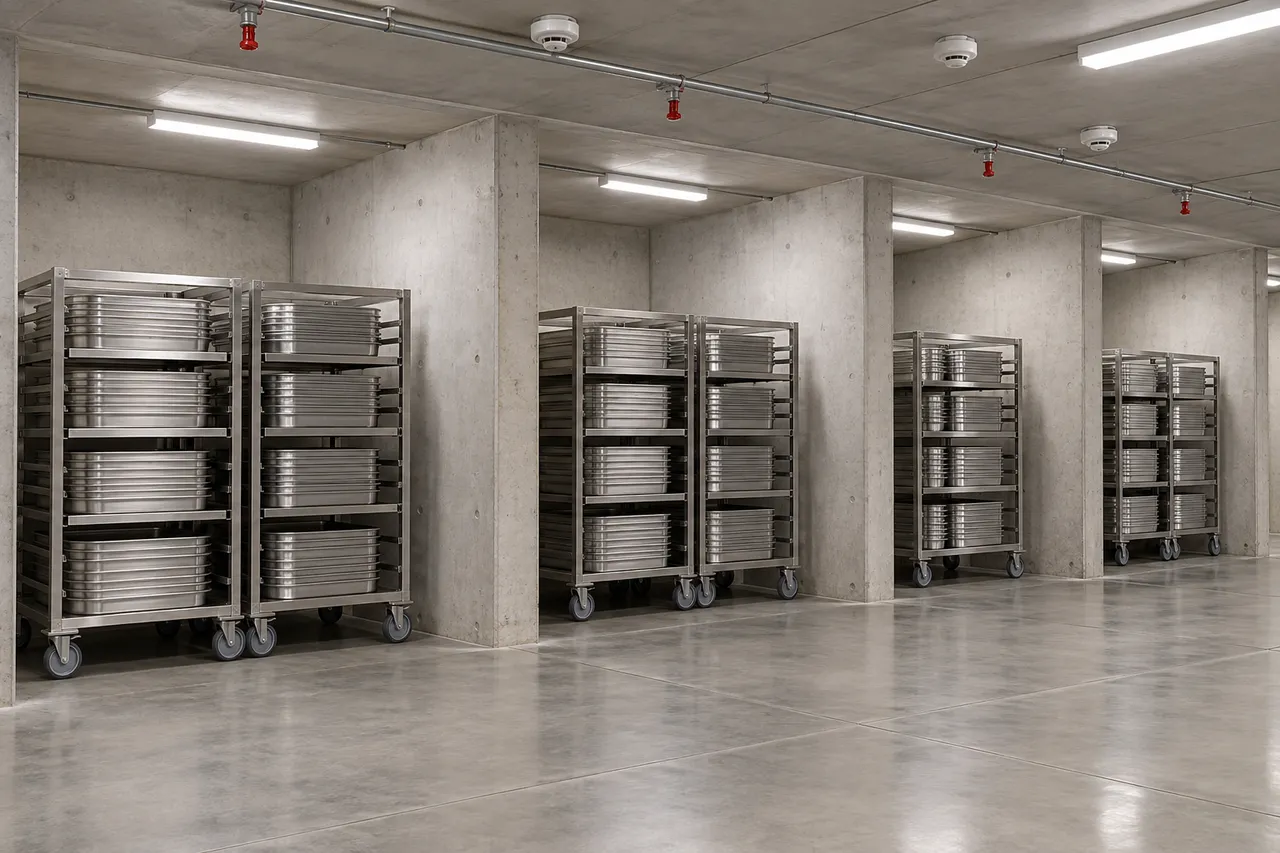
An illustrative image of a battery storage area divided by partition walls. It does not show any specific workplace or accident site.
MOEL's safety guide on preparing for fires and explosions in battery manufacturing and handling, released on October 21, 2024, describes accidents across the battery life cycle. In manufacturing, a battery explosion in June 2024 started a fire that killed 23 people and injured 8. In handling, a fire at a battery wholesale warehouse in August 2024 killed 1 person, and in disposal, a fire broke out while shredding waste batteries in January 2024 (MOEL safety guide).
The guide explains that a lithium battery that is damaged or exposed to high temperature or moisture can overheat and ignite, and that heat passing to surrounding batteries can lead to a large fire or explosion. Because a fault in one cell can spread to its neighbors, storage layout and separation matter as much as individual work rules.
The prevention measures in the guide are keeping humidity low and monitoring it in real time, checking for heat with thermal imaging cameras, and installing fire (gas) detection and alarm devices. Defective batteries are to be stored separately, flame-retardant trays and steel carts used, and stock spread out behind partition walls. The guide also calls for fire suppression equipment in each separated space, at least one emergency exit in addition to the main entrance, and evacuation drills. Its ten rules include training every worker, foreign workers included, keeping batteries away from water, friction and impact, and regularly identifying and fixing hazards.
After the June 24, 2024 battery plant fire in Hwaseong, the government announced measures to prevent battery plant fires on September 10, 2024, including a plan to designate lithium batteries and similar items as special combustibles under the Fire Prevention Act (Korea.kr policy briefing). The draft decree works through the Occupational Safety and Health Act rather than fire law, applying process safety management to lithium-thionyl chloride primary battery manufacturing, and MOEL gives the prevention of recurring fires and explosions at industrial sites as its reason.
Wider disclosure of workplace accident counts
Article 10 of the Occupational Safety and Health Act requires the Minister of Employment and Labor to publish the number of workplace accidents, the accident rate or its ranking, and similar information for workplaces specified by presidential decree. For principal contractors' workplaces specified by presidential decree where subcontractors' workers are working, the published figures include the subcontractors' accidents.
Article 10(1)1 of the current Enforcement Decree covers workplaces with two or more fatalities a year. The draft lowers this to one or more and deletes item 2, which covers workplaces whose fatality rate per 10,000 workers is at or above the average for the same industry and size band. Workplaces with a major industrial accident, workplaces that concealed accidents, and workplaces that failed to report accidents two or more times in the last three years remain covered, simply renumbered as items 2 to 4. The draft sets this provision to take effect on January 1, 2027.
According to press coverage, the aim is to align the disclosure threshold with the serious accident standard in the Serious Accidents Punishment Act and to strengthen companies' accountability for safety management (Energy Daily). How many additional workplaces would be published has not been confirmed in official material.
Publication is an action taken by the Minister, and it is a different system from the corporate safety and health disclosure system that took effect on August 1. Who must disclose and what they report is covered in the field-guide special edition Safety and Health Disclosure.
The draft Enforcement Rule and Standards Rules
The draft decree also changes the baseline teaching hours for core staff at worker safety and health training institutions and job training institutions from 12 hours per quarter to 24 hours per half year. The change aligns with the cycle of regular worker training and would take effect on promulgation.
The draft Enforcement Rule adds logging work to the list of tasks that require special training and makes clear that fire watch work is included. It also adds to confined-space special training the hazards of confined spaces, the emergency contact for the local fire station, and the location and use of escape equipment (MOEL notice on the draft rule).
Four items in the draft Standards Rules concern fire, explosion and release prevention. The draft adds checking for scattering sparks and spatter and for any outbreak of fire to the duties of the fire watch during welding and cutting (draft Article 241-2), and allows equipment handling acutely toxic substances to use a safety valve with downstream treatment equipment as an alternative to a rupture disc (draft Article 262). It also clarifies that safety devices on chemical equipment must be checked for malfunction before use (draft Article 277), and specifies which underground workplaces require flammable gas concentration measurement (draft Article 296) (MOEL notice on the draft Standards Rules).
The same draft includes provisions on concrete placing equipment and logging, and a new cold-weather work health protection provision (draft Article 563). The cold-weather provision is at the advance notice stage, so its details are better reviewed once it is final.
Field checklist
- If you manufacture lithium-thionyl chloride primary batteries, compare the wording of draft Article 43(1)8 with your own process to judge whether you would be covered.
- If you could become newly covered, assign owners and document locations now for process safety information, the process hazard assessment, the safe operation plan and the emergency response plan.
- Build committee review or consultation with the workers' representative into the report schedule.
- Compare humidity control, heat checks, fire and gas detection and alarms, separate storage of defective batteries, and partitioning in battery storage areas against the 2024 government guide.
- If you have had a recent fatality, factor into your prevention plan that the disclosure threshold may drop to one fatality a year from January 1, 2027.
- Compare the fire watch duties in your hot work procedure and your pre-use checks on chemical equipment with the draft Standards Rules.
- If you have comments, submit them by August 24 through the National Participatory Legislation Center or the other listed channels.
Summary
The draft Enforcement Decree would add lithium-thionyl chloride primary battery manufacturing to the process safety report list and lower the accident disclosure threshold to one fatality a year, and it is still at the advance notice stage. Comments are due by August 24 and can be sent through the National Participatory Legislation Center or by mail, email or fax. Check the final text and promulgation date on the National Law Information Center (law.go.kr).
Continuous records help show how process equipment condition changes between scheduled inspections. Tools that continuously track equipment condition through sound, vibration and temperature signals, such as XyloZero, can serve as a record that complements scheduled inspections. Such tools do not replace the legally required process safety report or fire detection and alarm devices.
The effective dates of the 2026 Occupational Safety and Health Act changes are covered in field guide part 1, 2026 Occupational Safety and Health Act Changes.
Official sources
- MOEL Notice No. 2026-362, advance notice of the draft partial amendment to the Enforcement Decree of the Occupational Safety and Health Act
- MOEL Notice No. 2026-363, advance notice of the draft partial amendment to the Enforcement Rule of the Occupational Safety and Health Act
- MOEL Notice No. 2026-364, advance notice of the draft partial amendment to the Rules on Occupational Safety and Health Standards
- MOEL, safety guide on preparing for fires and explosions in battery manufacturing and handling (October 2024)
- Korea.kr policy briefing, government measures to prevent battery plant fires (September 2024)
- National Law Information Center, current Occupational Safety and Health Act and Enforcement Decree