

DCASE 2026: Machine Sound Anomaly Detection Takes On Real-World Noise
Industry Operations Note special edition: machine anomalous sound detection research
DCASE Task 2, the research challenge on finding machine faults by sound, turned its 2026 edition toward real-world noise. This year's change: two-channel audio recorded at the same time near and far from the target machine, with systems trained on normal sounds only and asked to find anomalies through the noise.
This article was written against the DCASE 2026 task page, the official results table, and the task overview paper (arXiv 2606.01578 v1) as of September 12, 2026.
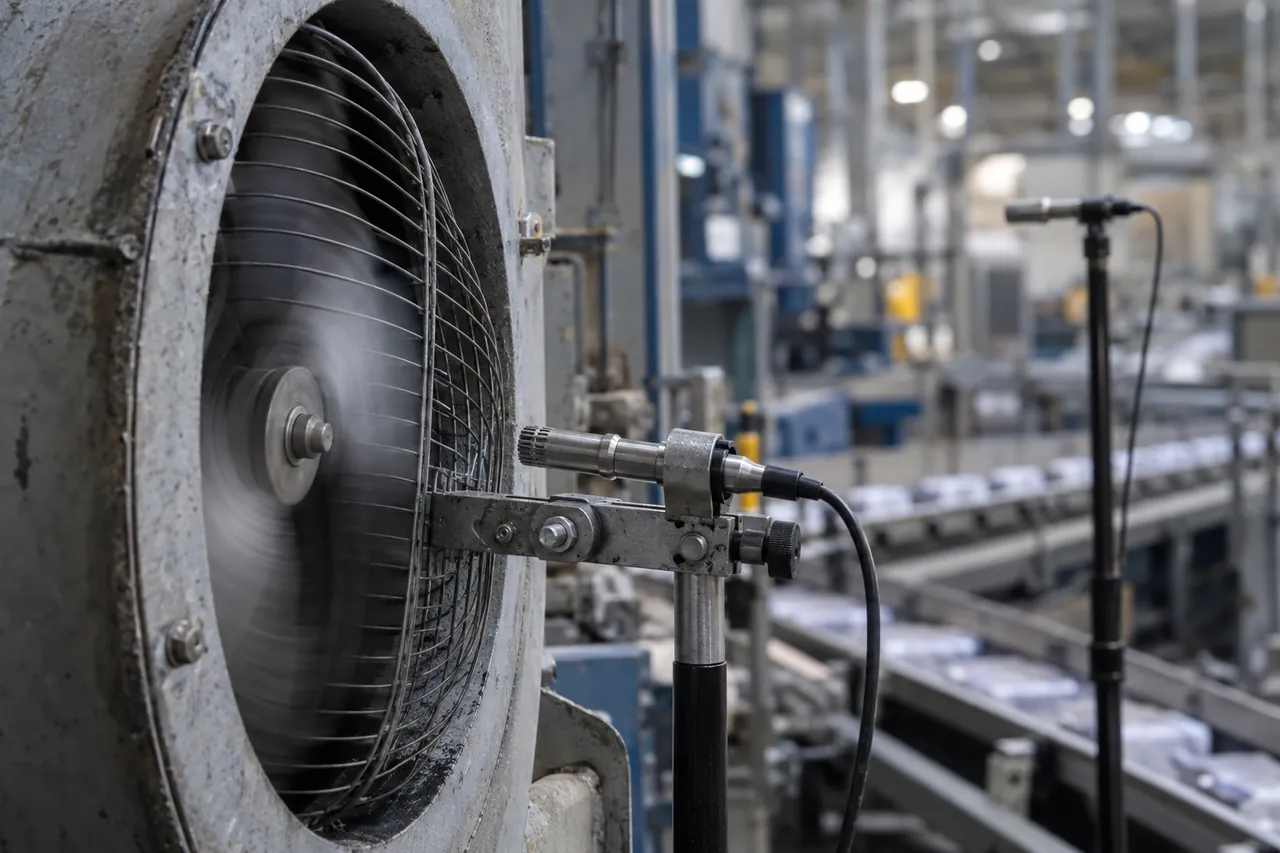
Illustrative image for machine anomalous sound detection research. It does not show an actual DCASE recording site or any specific product.
This year's task: noise-aware unsupervised detection
The official 2026 Task 2 title is Noise-aware Unsupervised Anomalous Sound Detection for Machine Condition Monitoring. The task description went public on February 1 and the full task on April 1 (DCASE 2026 task page). The setting is unsupervised: training data contains only normal machine sounds, so systems must detect anomalies without ever hearing one.
In the overview paper, the organizers note that earlier setups carried limited information about environmental noise, which could limit performance in high-noise conditions. Real sites have many noise sources, so detecting anomalies under heavy noise matters. That is the motivation for this year's task (arXiv 2606.01578). The task was organized by researchers from Hitachi, NTT, SB Intuitions, and Kyoto University.
A near microphone and a far microphone
This year's data is two-channel audio recorded simultaneously near the target machine (channel 1) and farther away (channel 2). The far microphone picks up relatively stronger environmental noise and weaker direct machine sound. Comparing the two channels gives a cue for separating environmental noise from machine sound.
Part of the data is emulated (Emu). The organizers measured impulse responses from the machine and speaker positions to both microphones, then convolved them with pre-recorded machine sounds and environmental noise to build two-channel audio. The data draws on earlier DCASE datasets such as MIMII, ToyADMOS, MIMII DG, and ToyADMOS2.
The development set covers seven machine types: fan, gearbox (Emu), bearing (Emu), slide rail (Emu), ToyCar (Emu), ToyCar, and valve (Emu). Evaluation machines were released separately on May 15 and include ToyDrone, ToothBrush, SewingMachine, Sander, and BlowerDustCollector. Clips run 10-12 seconds, and each machine comes with 990 normal training clips from the source domain plus 10 from the target domain, where operating conditions have changed.
The task page lists five requirements:
- Train on normal sounds only.
- Handle domain shift from changing operating conditions.
- Generalize to machine types not seen before.
- Work with or without machine attribute information.
- Use the two-channel recordings.
How the task has evolved since 2020
Task 2 has added field conditions to the problem step by step. After changing operating conditions and new machine types, this year brought in ambient noise.
| Year | Task focus |
|---|---|
| 2020 | Unsupervised anomalous sound detection introduced |
| 2021 | Domain shift (changing operating conditions) |
| 2022 | Domain generalization |
| 2023-2025 | First-shot: unseen machine types, no tuning on test data |
| 2026 | Noise-aware: near and far two-channel microphones |
Source: DCASE 2026 Task 2 overview paper (arXiv 2606.01578, June 1, 2026)
Results: 50-plus teams, 170-plus systems
Evaluation data came out on June 1, submissions closed on June 15, and results were published on June 30. The official ranking lists more than 170 systems from more than 50 teams (official results).
The official score is the harmonic mean, across all machine types, of AUC over all domains and pAUC over the false positive rate range 0-0.1. There are two baselines: an autoencoder on log-mel spectrograms scored by reconstruction error (MSE), and a Mahalanobis-distance method, with official scores of 59.80 and 54.76. The top score, 70.24, went to a MERL system (Fujimura_MERL_task2_3).
The MSE baseline ranked 68th among systems. Many systems scored below it, which shows how hard this year's task was. These scores are ranking metrics computed on benchmark data, not field detection rates.
Method trend: pretrained audio models
The system characteristics table on the results page is self-reported by the teams. According to it, the winning system used embeddings from a pretrained audio model (BEATs) together with mixup augmentation. Other systems often pair embeddings from pretrained models such as BEATs, EAT, or CED with distance-based scoring such as kNN.
Because the data is self-reported, exact shares are hard to state. The trend toward using models pretrained on large audio corpora as feature extractors is still visible. Overview paper v1 contains no results and says results and analysis will be added after the submission deadline. The organizers' official interpretation should be checked in a revised paper or the workshop talks.
What to check when evaluating sound-based equipment monitoring
The challenge design maps onto the questions to ask before a field deployment.
- Record the operating conditions under which normal sounds were collected, and plan to recheck when conditions change.
- Decide how to respond when little normal data is available after an operating change.
- Log microphone positions together with nearby noise sources, and compare the sound near the machine with the sound farther away.
- Confirm whether the evaluation metric looks separately at the low false-alarm range.
- Check whether the same approach holds as equipment types are added, or whether each machine needs tuning.
- Do not read benchmark scores as field detection rates; validate again on your own equipment data.
Summary
2026 Task 2 signals that unsupervised machine anomalous sound detection research now tackles field noise head-on. An applied and industrial research workshop (AIR) is scheduled at MIT on October 27, followed by the main workshop at Tufts University on October 28-29, both in Boston (DCASE 2026 workshop), so read the results alongside those talks and any revised overview paper. Task rules and scores are on the official DCASE 2026 page.
Just as the research task now accounts for noise, field monitoring should be designed around ambient noise and changing operating conditions. Tools for continuous equipment monitoring with sound, vibration, and environmental signals should be evaluated under the same conditions, and XyloZero is one such tool.
Note 3 of 6, Acoustic and Vibration Monitoring: Choosing the Right Signal, covers the basics of sound and vibration signals.